A Complete Derivation of the Fermion Spectrum from the Recognition Composition Law
Jonathan Washburn, Elshad Allahyarov
physics.gen-ph
Jun 15, 2025 · v1
TL;DR
All structural theorems behind the claimed fermion-mass derivation are machine-verified in Lean 4 across 179 files with zero sorry.
Abstract
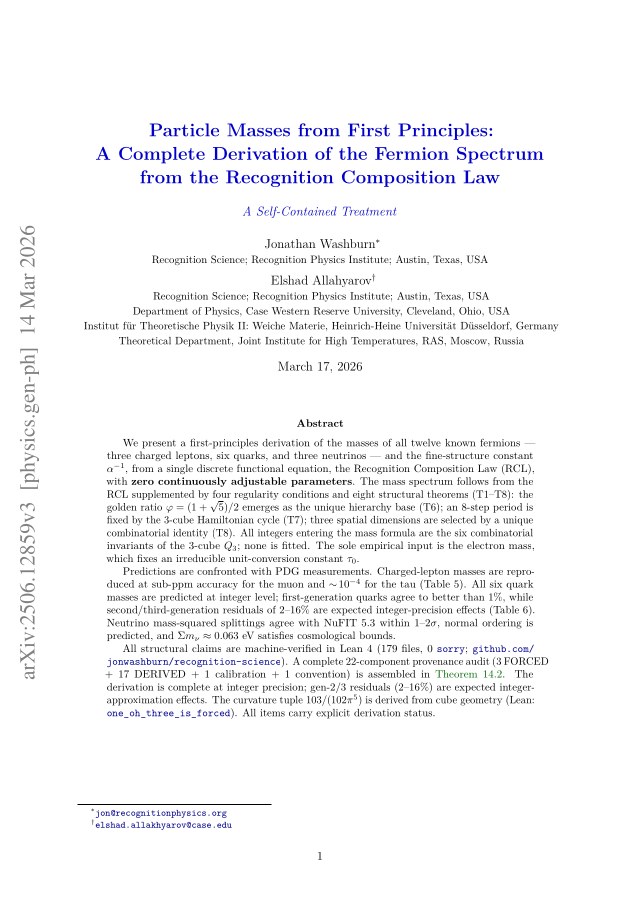
We present a first-principles derivation of the masses of all twelve known fermions – three charged leptons, six quarks, and three neutrinos – and the fine-structure constant $α^{-1}$, from a single discrete functional equation, the Recognition Composition Law (RCL), with zero continuously adjustable parameters. The mass spectrum follows from the RCL supplemented by four regularity conditions and eight structural theorems (T1–T8): the golden ratio $\varphi=(1+\sqrt{5})/2$ emerges as the unique hierarchy base (T6); an 8-step period is fixed by the 3-cube Hamiltonian cycle (T7); three spatial dimensions are selected by a unique combinatorial identity (T8). All integers entering the mass formula are the six combinatorial invariants of the 3-cube $Q_3$; none is fitted. The sole empirical input is the electron mass, which fixes an irreducible unit-conversion constant $τ_0$. Predictions are confronted with PDG measurements. Charged-lepton masses are reproduced at sub-ppm accuracy for the muon and $\sim\!10^{-4}$ for the tau (Table \ref{tab:lepton_validation}). All six quark masses are predicted at integer level; first-generation quarks agree to better than $1\%$, while second/third-generation residuals of $2$–$16\%$ are expected integer-precision effects (Table \ref{tab:quark_validation}). Neutrino mass-squared splittings agree with NuFIT 5.3 within $1$–$2σ$, normal ordering is predicted, and $Σm_ν\approx 0.063$ eV satisfies cosmological bounds. All structural claims are machine-verified in Lean 4 (179 files, 0 sorry; github.com/\allowbreak jonwashburn/\allowbreak recognition-science).
Problem
The masses of the twelve known fermions and the fine-structure constant lack a first-principles derivation from a single discrete functional equation with zero continuously adjustable parameters.
Approach
The authors derive the fermion mass spectrum from the Recognition Composition Law (RCL) supplemented by four regularity conditions and eight structural theorems. The golden ratio emerges as the unique hierarchy base, an 8-step period is fixed by the 3-cube Hamiltonian cycle, and three spatial dimensions are selected by a combinatorial identity. All structural claims are machine-verified in Lean 4 (179 files, 0 sorry).
Results
Charged-lepton masses are reproduced at sub-ppm accuracy for the muon and 10^-4 for the tau. All six quark masses are predicted at integer level (first-generation within 1%, second/third-generation residuals of 2-16%). Neutrino mass-squared splittings agree with NuFIT 5.3 within 1-2 sigma, normal ordering is predicted, and the sum of neutrino masses ( 0.063 eV) satisfies cosmological bounds.