Formalizing dimensional analysis using the Lean theorem prover
Maxwell P. Bobbin, Colin Jones, John Velkey, Tyler R. Josephson
physics.chem-ph
Sep 16, 2025 · v1
TL;DR
Uses Lean 4 to formalize dimensional analysis, proving physical dimensions form an Abelian group and implementing the Buckingham Pi Theorem.
Abstract
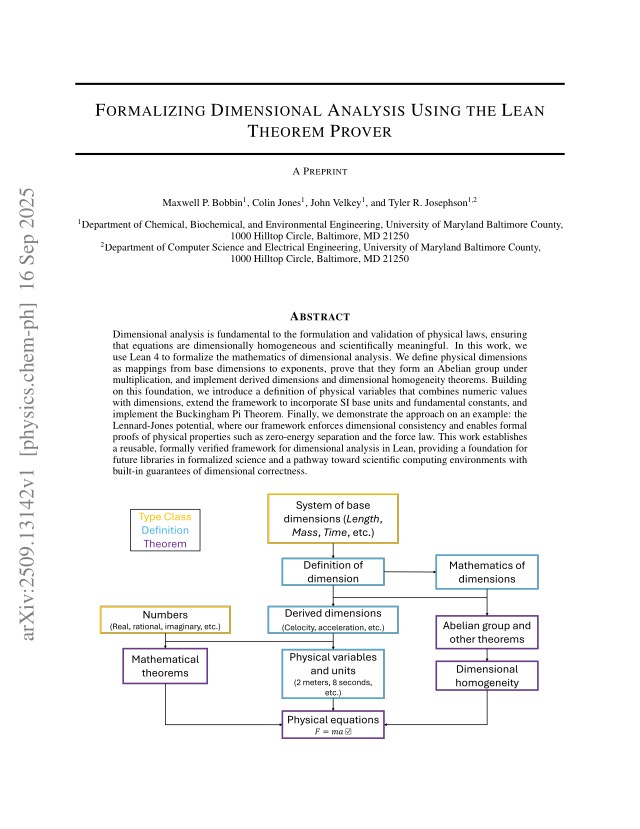
Dimensional analysis is fundamental to the formulation and validation of physical laws, ensuring that equations are dimensionally homogeneous and scientifically meaningful. In this work, we use Lean 4 to formalize the mathematics of dimensional analysis. We define physical dimensions as mappings from base dimensions to exponents, prove that they form an Abelian group under multiplication, and implement derived dimensions and dimensional homogeneity theorems. Building on this foundation, we introduce a definition of physical variables that combines numeric values with dimensions, extend the framework to incorporate SI base units and fundamental constants, and implement the Buckingham Pi Theorem. Finally, we demonstrate the approach on an example: the Lennard-Jones potential, where our framework enforces dimensional consistency and enables formal proofs of physical properties such as zero-energy separation and the force law. This work establishes a reusable, formally verified framework for dimensional analysis in Lean, providing a foundation for future libraries in formalized science and a pathway toward scientific computing environments with built-in guarantees of dimensional correctness.
Problem
Dimensional analysis is fundamental to validating physical laws, but lacks a rigorous formal foundation in a proof assistant that can enforce dimensional homogeneity and catch unit errors at compile time.
Approach
The authors use Lean 4 to formalize dimensional analysis. They define physical dimensions as mappings from base dimensions to exponents, prove dimensions form an Abelian group under multiplication, and implement derived dimensions and dimensional homogeneity theorems. Physical variables combine numeric values with dimensions, extending the framework to arithmetic operations on dimensioned quantities.
Results
The formalization provides a complete Lean 4 framework for dimensional analysis covering the seven SI base dimensions, derived dimensions, and dimensional homogeneity checking. An application to the Lennard-Jones potential demonstrates the system catching dimensionally inconsistent equations.