
← All papers
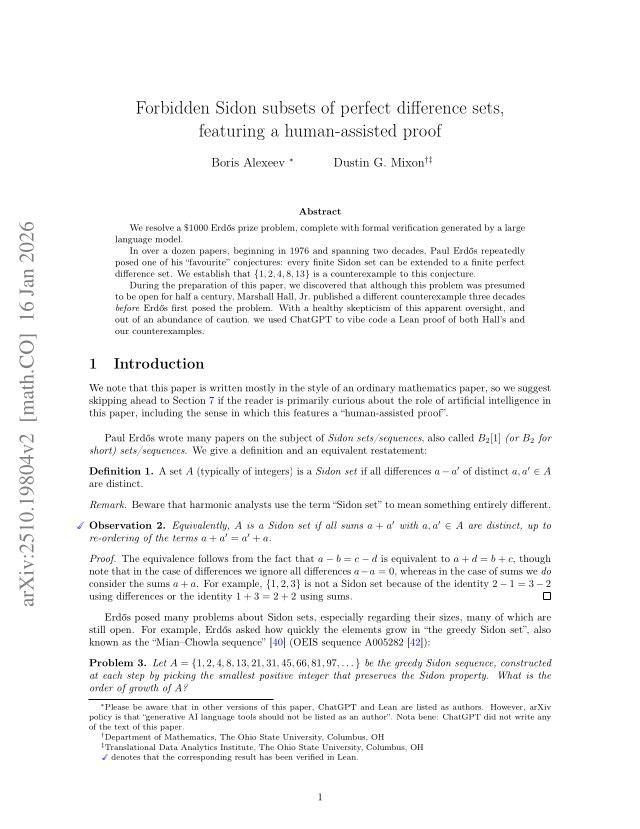
Forbidden Sidon subsets of perfect difference sets, featuring a human-assisted proof
math.CO
Oct 22, 2025 · v1
TL;DR
Uses ChatGPT to generate a Lean proof verifying counterexamples to an Erds Sidon-set conjecture.
Abstract
We resolve a $1000 Erdős prize problem, complete with formal verification generated by a large language model. In over a dozen papers, beginning in 1976 and spanning two decades, Paul Erdős repeatedly posed one of his "favourite" conjectures: every finite Sidon set can be extended to a finite perfect difference set. We establish that {1, 2, 4, 8, 13} is a counterexample to this conjecture. During the preparation of this paper, we discovered that although this problem was presumed to be open for half a century, Marshall Hall, Jr. published a different counterexample three decades before Erdős first posed the problem. With a healthy skepticism of this apparent oversight, and out of an abundance of caution, we used ChatGPT to vibe code a Lean proof of both Hall's and our counterexamples.
Problem
Paul Erdos conjectured repeatedly from 1976 onward that every finite Sidon set can be extended to a finite perfect difference set. This $1000 prize problem was presumed open for half a century.
Approach
The authors establish that {1, 2, 4, 8, 13} is a counterexample to Erdos's conjecture. They also discovered that Marshall Hall, Jr. had published a different counterexample three decades before Erdos first posed the problem. ChatGPT (GPT-5) was used to vibe-code a Lean proof of both Hall's and their counterexamples.
Results
The conjecture is resolved in the negative: {1, 2, 4, 8, 13} is a Sidon set that cannot be extended to a finite perfect difference set. Both this counterexample and Hall's earlier one are formally verified in Lean with LLM assistance.