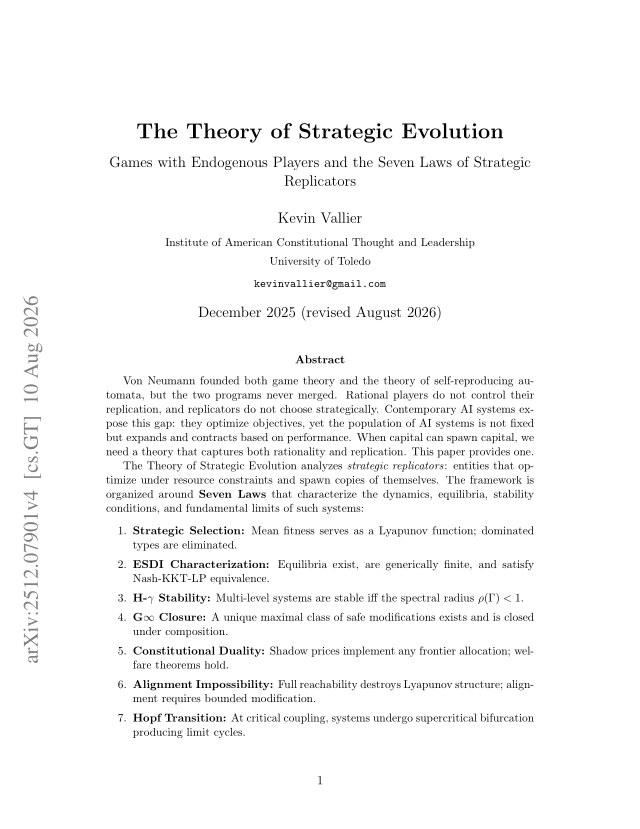
The Theory of Strategic Evolution: Games with Endogenous Players and the Seven Laws of Strategic Replicators
Kevin Vallier
cs.GT
Dec 5, 2025 · v4
cs.AI cs.CY cs.MA econ.TH
TL;DR
All seven laws are formalized in Lean 4 with Mathlib: 240 theorems with zero custom axioms and no sorry, in a public repository.
Abstract
Von Neumann founded both game theory and the theory of self-reproducing automata, but the two programs never merged. Rational players do not control their replication, and replicators do not choose strategically. Contemporary AI systems expose this gap: they optimize objectives, yet the population of AI systems is not fixed but expands and contracts based on performance. When capital can spawn capital, we need a theory that captures both rationality and replication. The Theory of Strategic Evolution analyzes strategic replicators: entities that optimize under resource constraints and spawn copies of themselves. The framework is organized around Seven Laws: 1. Strategic Selection: Mean fitness serves as a Lyapunov function; dominated types are eliminated. 2. ESDI Characterization: Equilibria exist, are generically finite, and satisfy Nash-KKT-LP equivalence. 3. H-$γ$ Stability: Multi-level systems are stable iff the spectral radius $ρ(Γ) < 1$. 4. G$\infty$ Closure: A unique maximal class of safe modifications exists and is closed under composition. 5. Constitutional Duality: Shadow prices implement any frontier allocation; welfare theorems hold. 6. Alignment Impossibility: Full reachability destroys Lyapunov structure; alignment requires bounded modification. 7. Hopf Transition: At critical coupling, systems undergo supercritical bifurcation producing limit cycles. Applications range from AI deployment dynamics to institutional design. The framework shows why "personality engineering" fails under selection pressure and identifies constitutional constraints necessary for stable alignment. The Lean 4 formalization verifies every result with zero custom axioms. The framework generates empirical predictions that remain untested. The paper and its repository are therefore a prototype kernel: an instrument for studying strategic replicators, not a set of results about the world.
Problem
Game theory treats players as fixed, while replicator theory treats replication as blind to strategy. AI systems that optimize objectives and also expand or contract their own populations need a framework that combines rational choice with replication.
Approach
The paper defines strategic replicators through the RUPSI axioms and models them as Games with Endogenous Players. It derives Seven Laws covering Lyapunov selection, equilibrium characterization (Nash-KKT-LP equivalence), multi-level spectral-radius stability, closure of safe modifications, constitutional duality via shadow prices, an alignment impossibility result, and a Hopf bifurcation. All results are machine-checked in Lean 4 with Mathlib, and a theorem-by-theorem contract maps each claim to its Lean statement.
Results
The Lean development contains 240 theorems, 141 of them audited headline results. It compiles cold from a clean checkout and depends only on the standard axioms (propext, Classical.choice, Quot.sound), with no sorry or native_decide. The empirical predictions the framework generates remain untested.