Parity of $k$-differentials in genus zero and one
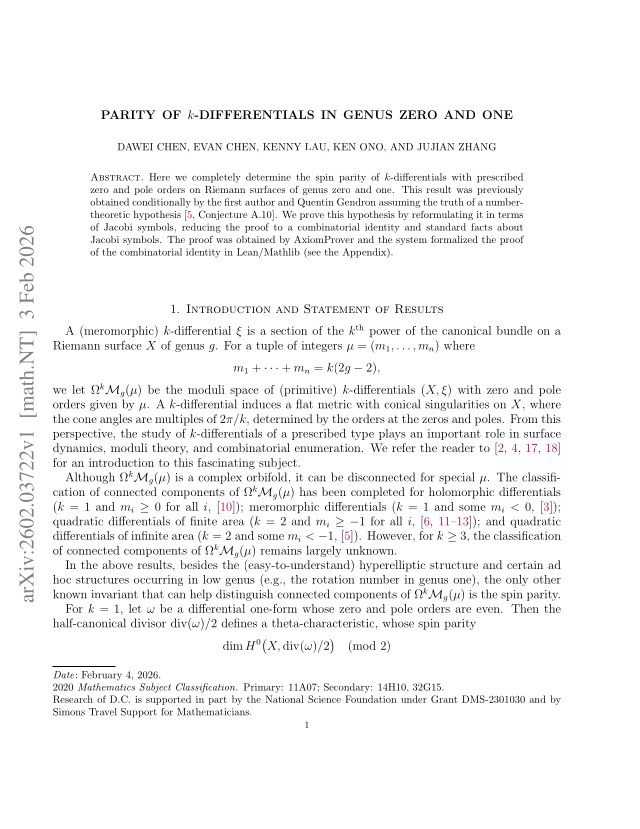
Determining the spin parity of k-differentials with prescribed zero and pole orders on genus zero and one Riemann surfaces had been reduced to a number-theoretic hypothesis (Conjecture A.10 of Chen–Gendron) that remained unproven.
The conjecture is reformulated using Jacobi symbols, exploiting that floor((k+1)/4) mod 2 is periodic modulo 8 and matches the symbol (2/k). Via the Eisenstein and Gauss–Schering lemmas and the supplementary law, the proof reduces to an explicit combinatorial floor-sum identity (Lemma 2.5). AxiomProver, an AI system, was given only the conjecture statement and found this reformulation. It then autonomously produced Lean 4 files formalizing the statement and proof of Lemma 2.5.
The conjecture is proved, which completely determines the spin parity of k-differentials in genus zero and one. The Lean proof of the combinatorial identity is verified, and it shows that an assumed gcd hypothesis is unnecessary.