Simultaneous Degradation of Percolation and Cascade Robustness Under Targeted Hub Removal
Federico Hernan Cachero Sanchez
physics.soc-ph
Mar 5, 2026 · v3
TL;DR
Key analytical claims (stable-node condition, cascade onset bound, monotonicity of percolation threshold under hub removal) are formalized in Lean 4 in the accompanying repository.
Abstract
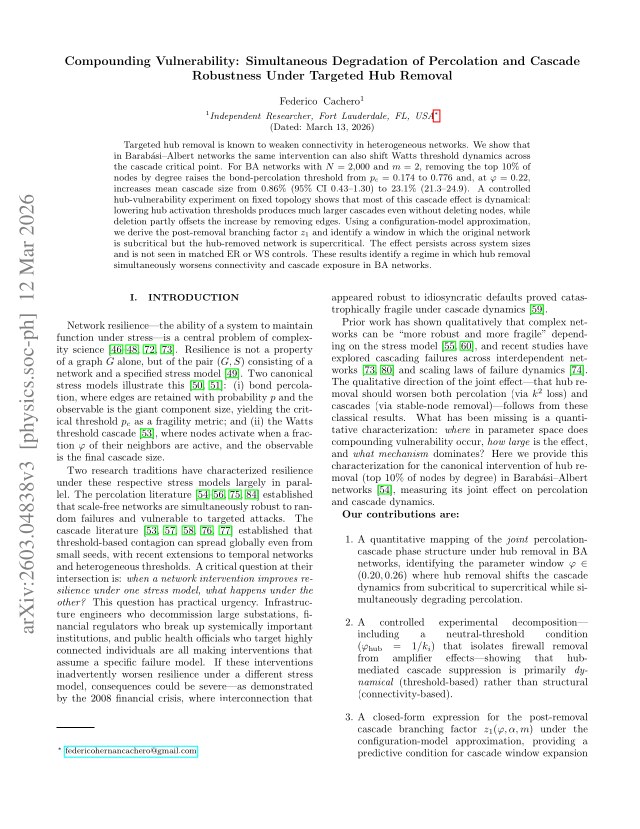
Targeted hub removal is known to weaken connectivity in heterogeneous networks. We show that in Barabási–Albert networks the same intervention can also shift Watts threshold dynamics across the cascade critical point. For BA networks with $N=2{,}000$ and $m=2$, removing the top 10% of nodes by degree raises the bond-percolation threshold from $p_c=0.174$ to $0.776$ and, at $\varphi=0.22$, increases mean cascade size from $0.86\%$ (95% CI 0.43–1.30) to $23.1\%$ (21.3–24.9). A controlled hub-vulnerability experiment on fixed topology shows that most of this cascade effect is dynamical: lowering hub activation thresholds produces much larger cascades even without deleting nodes, while deletion partly offsets the increase by removing edges. Using a configuration-model approximation, we derive the post-removal branching factor $z_1$ and identify a window in which the original network is subcritical but the hub-removed network is supercritical. The effect persists across system sizes and is not seen in matched ER or WS controls. These results identify a regime in which hub removal simultaneously worsens connectivity and cascade exposure in BA networks.
Problem
Removing hubs is known to weaken connectivity in heterogeneous networks, but its effect on Watts threshold cascades is less clear. The question is whether hub removal can also push networks across the cascade critical point.
Approach
Simulations on Barabási–Albert, Erdős–Rényi and Watts–Strogatz networks measure the bond-percolation threshold and Watts cascade sizes before and after removing the top 10% of nodes by degree. A controlled experiment changes hub activation thresholds on a fixed topology to separate dynamical effects from topological ones. A configuration-model approximation gives the post-removal branching factor z1. Key analytical claims are formalized in Lean 4.
Results
In BA networks (N=2000, m=2), hub removal raises p_c from 0.174 to 0.776. At φ=0.22 it raises mean cascade size from 0.86% to 23.1%, and z1 crosses from 0.850 to 1.195. Most of the cascade effect is dynamical, and the effect is absent in ER and WS controls.
| φ | z1 (pre) | z1 (post) | Regime |
|---|
| 0.18 | 1.136 | 1.363 | Both supercritical |
| 0.22 | 0.850 | 1.195 | Pre: sub, Post: super |
| 0.25 | 0.850 | 1.195 | Pre: sub, Post: super |
| 0.27 | 0.550 | 0.864 | Both subcritical |
Branching factor z1 before and after hub removal (BA, m=2)