
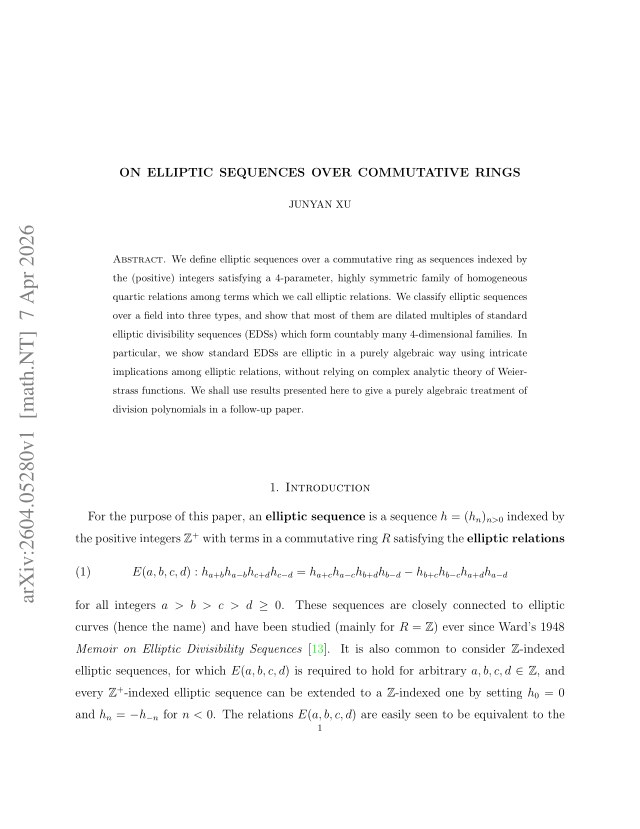
On Elliptic Sequences over Commutative Rings
Elliptic sequences and elliptic divisibility sequences are usually studied over the integers, often using complex-analytic tools such as Weierstrass functions. A purely algebraic theory over arbitrary commutative rings was sought, motivated by formalizing division polynomials in Lean.
Elliptic sequences are defined by a symmetric 4-parameter family of quartic elliptic relations, and implication rules among these relations are developed. Identity principles show when sequences are determined by their initial terms. Standard EDSs are built from an auxiliary sequence via the even-odd recurrence, and a translation invariant is derived. Most results are formalized in Mathlib (normEDS, preNormEDS) through a pull request.
Standard EDSs are proven elliptic by purely algebraic means. Elliptic sequences over a field are classified into three types, most being dilated multiples of standard EDSs forming countably many 4-dimensional families. The results support an algebraic treatment of division polynomials in a follow-up paper.