
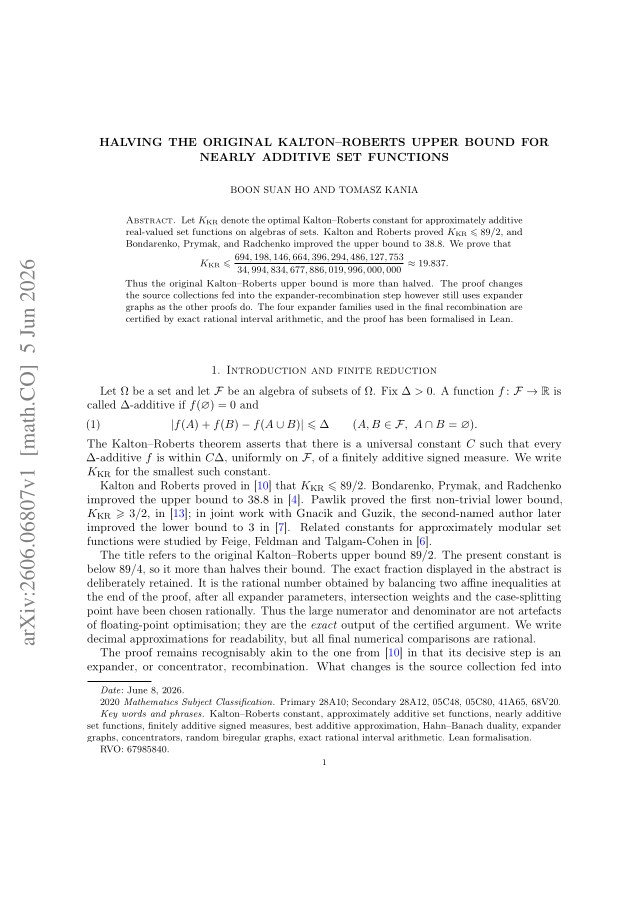
Halving the original Kalton–Roberts upper bound for nearly additive set functions
The optimal Kalton-Roberts constant K_KR for approximating nearly additive set functions by finitely additive measures had an upper bound of 89/2 (original) and 38.8 (improved), but the gap to the lower bound of 3 remained large.
The proof modifies the source collections fed into the expander-recombination step of the Kalton-Roberts argument. Instead of minimising an oscillation and building a submeasure, it uses an l-infinity duality certificate for best approximation by additive measures, which supplies low-frequency near-extremal multisets. Rational mixtures of neighbouring intersection levels further reduce the frequencies. Four expander families are certified by exact rational interval arithmetic. The entire proof is formalized in Lean 4 (v4.28.0, 6.2k lines across 18 files).
The new bound is K_KR <= 694198146664396294486127753 / 34994834677886019996000000, approximately 19.837, more than halving the original Kalton-Roberts upper bound of 89/2. All numerical comparisons are exact rational arithmetic, and the Lean formalization covers the complete argument including the set-algebra statement.