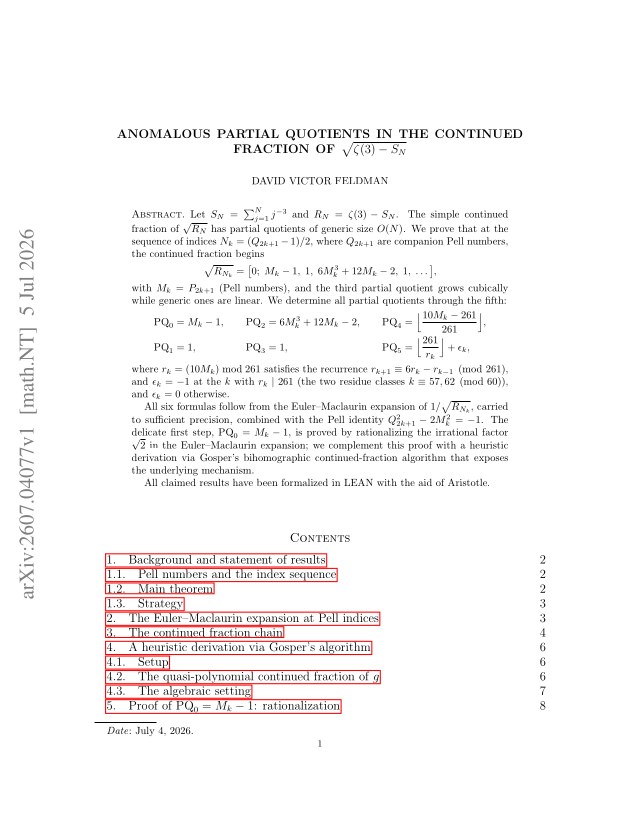
Anomalous Partial Quotients in the Continued Fraction of $\sqrt{ζ(3)-S_N}$
David Victor Feldman
math.NT
Jul 5, 2026 · v1
TL;DR
All claimed results on continued-fraction partial quotients of √(ζ(3)−S_N) at Pell indices were formalized in Lean with the aid of Aristotle.
Abstract
Let $S_N = \sum_{j=1}^N j^{-3}$ and $R_N = ζ(3) - S_N$. The simple continued fraction of $\sqrt{R_N}$ has partial quotients of generic size $O(N)$. We prove that at the sequence of indices $N_k = (Q_{2k+1}-1)/2$, where $Q_{2k+1}$ are companion Pell numbers, the continued fraction begins \[ \sqrt{R_{N_k}} = \bigl[0;\; M_k-1,\; 1,\; 6M_k^3+12M_k-2,\; 1,\; \ldots\,\bigr], \] with $M_k = P_{2k+1}$ (Pell numbers), and the third partial quotient grows cubically while generic ones are linear. We determine all partial quotients through the fifth: \begin{align*} \PQ_0 &= M_k - 1, & \PQ_2 &= 6M_k^3 + 12M_k - 2, & \PQ_4 &= \Bigl\lfloor\frac{10M_k - 261}{261}\Bigr\rfloor, \PQ_1 &= 1, & \PQ_3 &= 1, & \PQ_5 &= \Bigl\lfloor\frac{261}{r_k}\Bigr\rfloor + ε_k, \end{align*} where $r_k = (10M_k) \bmod 261$ satisfies the recurrence $r_{k+1} \equiv 6r_k - r_{k-1} \pmod{261}$, and $ε_k = -1$ at the $k$ with $r_k \mid 261$ (the two residue classes $k \equiv 57, 62 \pmod{60}$), and $ε_k = 0$ otherwise. All six formulas follow from the Euler–Maclaurin expansion of $1/\sqrt{R_{N_k}}$, carried to sufficient precision, combined with the Pell identity $Q_{2k+1}^2 - 2M_k^2 = -1$. The delicate first step, $\PQ_0 = M_k - 1$, is proved by rationalizing the irrational factor $\sqrt{2}$ in the Euler–Maclaurin expansion; we complement this proof with a heuristic derivation via Gosper's bihomographic continued-fraction algorithm that exposes the underlying mechanism. All claimed results have been formalized in LEAN with the aid of Aristotle.
Problem
For S_N = Σ j^{-3} and R_N = ζ(3) − S_N, the continued fraction of √(R_N) generically has partial quotients of size O(N). At a special sequence of indices tied to Pell numbers, anomalously large (cubic) partial quotients appear.
Approach
The index sequence N_k is chosen from companion Pell numbers so that 2N_k^2+2N_k+1 = M_k^2 with M_k a Pell number. An Euler–Maclaurin expansion of 1/√(R_{N_k}), controlled by an exact telescoping rational enclosure of the tail, is carried to high precision. Combined with the Pell identity Q^2 − 2M^2 = −1, the first six partial quotients are computed via a floor-and-invert chain, with the leading step proved by rationalizing the √2 factor. A heuristic derivation via Gosper's bihomographic continued-fraction algorithm is also given.
Results
Explicit formulas for the partial quotients PQ_0 through PQ_5 are established, showing PQ_2 = 6M_k^3+12M_k−2 grows cubically while generic quotients are linear, with PQ_5 governed by a residue recurrence mod 261. All claimed results were formalized in Lean.
| PQ | value |
|---|
| PQ_0 | M_k−1 |
| PQ_1 | 1 |
| PQ_2 | 6M_k^3+12M_k−2 |
| PQ_3 | 1 |
| PQ_4 | ⌊(10M_k−261)/261⌋ |
Partial quotients at Pell indices