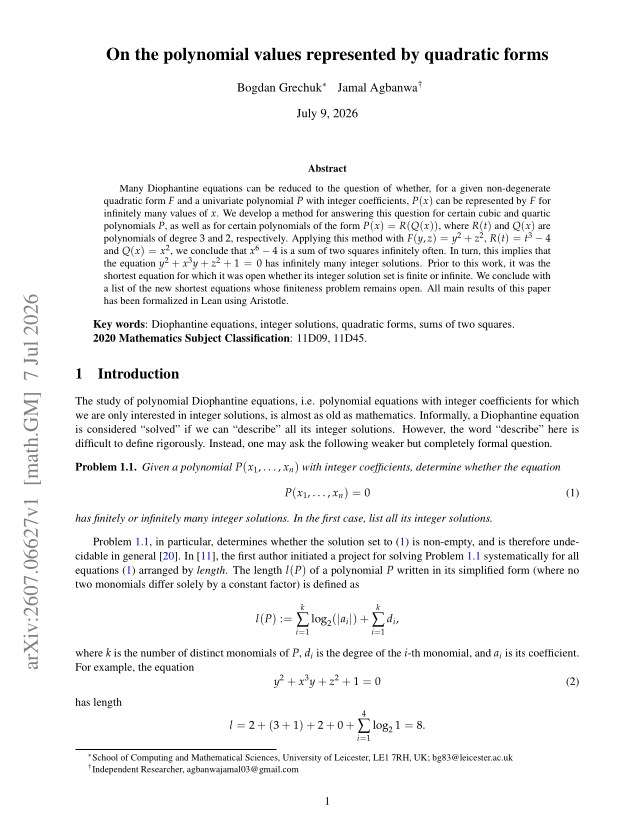
On the polynomial values represented by quadratic forms
Bogdan Grechuk, Jamal Agbanwa
math.GM
Jul 7, 2026 · v1
TL;DR
All main results, including that x^6-4 is a sum of two squares infinitely often, were formalized in Lean using Aristotle.
Abstract
Many Diophantine equations can be reduced to the question of whether, for a given non-degenerate quadratic form $F$ and a univariate polynomial $P$ with integer coefficients, $P(x)$ can be represented by $F$ for infinitely many values of $x$. We develop a method for answering this question for certain cubic and quartic polynomials $P$, as well as for certain polynomials of the form $P(x)=R(Q(x))$, where $R(t)$ and $Q(x)$ are polynomials of degree $3$ and $2$, respectively. Applying this method with $F(y,z)=y^2+z^2$, $R(t)=t^3-4$ and $Q(x)=x^2$, we conclude that $x^6-4$ is a sum of two squares infinitely often. In turn, this implies that the equation $y^2+x^3y+z^2+1=0$ has infinitely many integer solutions. Prior to this work, it was the shortest equation for which it was open whether its integer solution set is finite or infinite. We conclude with a list of the new shortest equations whose finiteness problem remains open. All main results of this paper has been formalized in Lean using Aristotle.
Problem
Given a non-degenerate quadratic form F and a univariate polynomial P, determine whether P(x) is represented by F for infinitely many integers x. This underlies deciding finiteness of solution sets for the shortest open Diophantine equations, notably y^2+x^3y+z^2+1=0.
Approach
A tangent-line construction produces infinitely many polynomial values represented by quadratic forms, reducing to a Pell-type auxiliary equation. The method handles certain cubic and quartic polynomials and compositions R(Q(x)) with cubic R and quadratic Q, and extends to arbitrary non-degenerate integral binary quadratic forms via explicit congruence conditions. All main results were formalized in Lean using Aristotle.
Results
Proves x^6-4 is a sum of two squares infinitely often, implying y^2+x^3y+z^2+1=0 has infinitely many integer solutions, resolving the shortest previously open equation. This completes classification for all equations of length l<9 and resolves four further length-9 equations, leaving twenty open.