New bounds for double covers of the discrete box {0,1,2}^d
Patrick White
math.CO
Jul 10, 2026 · v1
TL;DR
The lower bound f(6)>=60 is machine-checked in Lean 4, relying only on the three standard Mathlib axioms.
Abstract
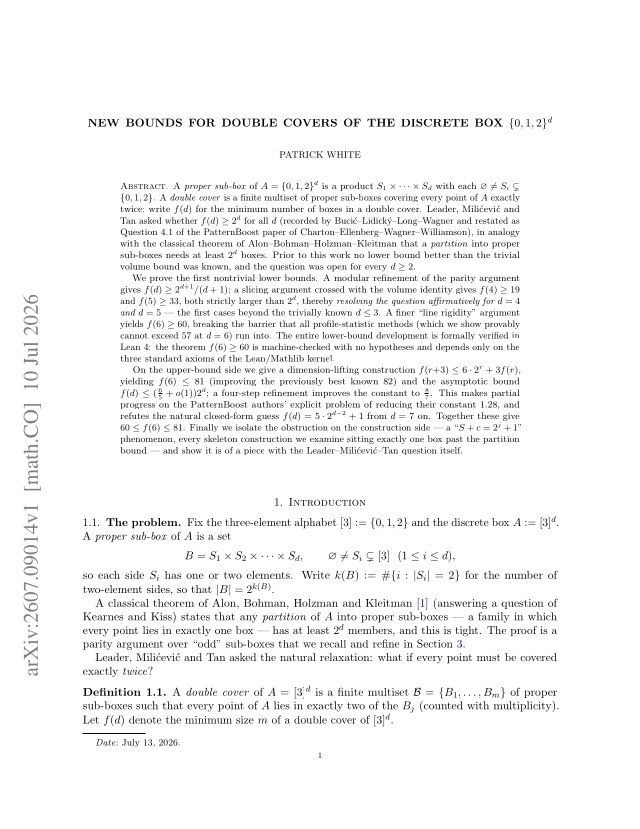
A proper sub-box of $A=\{0,1,2\}^d$ is a product $S_1\times\dots\times S_d$ with each $\varnothing\neq S_i\subsetneq\{0,1,2\}$. A double cover is a finite multiset of proper sub-boxes covering every point of $A$ exactly twice; write $f(d)$ for the minimum size of a double cover. Leader, Milicevic and Tan asked whether $f(d)\ge 2^d$ for all $d$ (Question 4.1 of the PatternBoost paper of Charton-Ellenberg-Wagner-Williamson), analogous to the Alon-Bohman-Holzman-Kleitman partition bound $2^d$. No better than the trivial volume bound was previously known, for any $d\ge 2$. We prove the first nontrivial lower bounds. A modular refinement of the parity argument gives $f(d)\ge 2^{d+1}/(d+1)$; a slicing argument gives $f(4)\ge 19$, $f(5)\ge 33$, both above $2^d$, resolving the question for $d=4,5$ – the first cases beyond the trivially known $d\le 3$. A finer "line rigidity" argument yields $f(6)\ge 60$, breaking the profile-statistic barrier (capped at $57$, shown here). This is formally verified in Lean 4: $f(6)\ge 60$ is machine-checked on the three standard Mathlib axioms alone. On the upper-bound side, a dimension-lifting construction $f(r+3)\le 6\cdot 2^r+3f(r)$ gives $f(6)\le 81$ (improving the known $82$) and $f(d)\le(\tfrac65+o(1))2^d$ asymptotically; a refinement improves the constant to $\tfrac87$. This makes partial progress on PatternBoost's problem of reducing their constant $1.28$, and refutes the closed-form guess $f(d)=5\cdot 2^{d-2}+1$ from $d=7$ on. Together, $60\le f(6)\le 81$. Finally we isolate the construction-side obstruction – an "S+c=2^j+1" phenomenon, every skeleton sitting exactly one box past the partition bound – and show it is of a piece with the Leader-Milicevic-Tan question itself.
Problem
For A={0,1,2}^d, a double cover is a multiset of proper sub-boxes covering each point exactly twice; f(d) is the minimum size. Leader-Milicevic-Tan asked whether f(d)>=2^d, with no nontrivial bounds previously known for d>=2.
Approach
A modular refinement of the parity argument (mod 4) yields f(d)>=2^{d+1}/(d+1). A slicing recursion bootstraps lower bounds across dimensions, and a finer line-rigidity argument controls axis-line structure to push f(6) past the profile barrier. The lower bound f(6)>=60 is formally verified in Lean 4, checked against only the three standard Mathlib axioms. Upper bounds come from a dimension-lifting leapfrog construction f(r+3)<=6*2^r+3f(r).
Results
The bounds f(4)>=19 and f(5)>=33 resolve Question 1.2 for d=4,5, and line rigidity gives f(6)>=60, breaking the profile-statistic ceiling of 57. On the upper side f(6)<=81 and asymptotically f(d)<=(8/7+o(1))2^d, giving 60<=f(6)<=81 and refuting a conjectured closed form.