
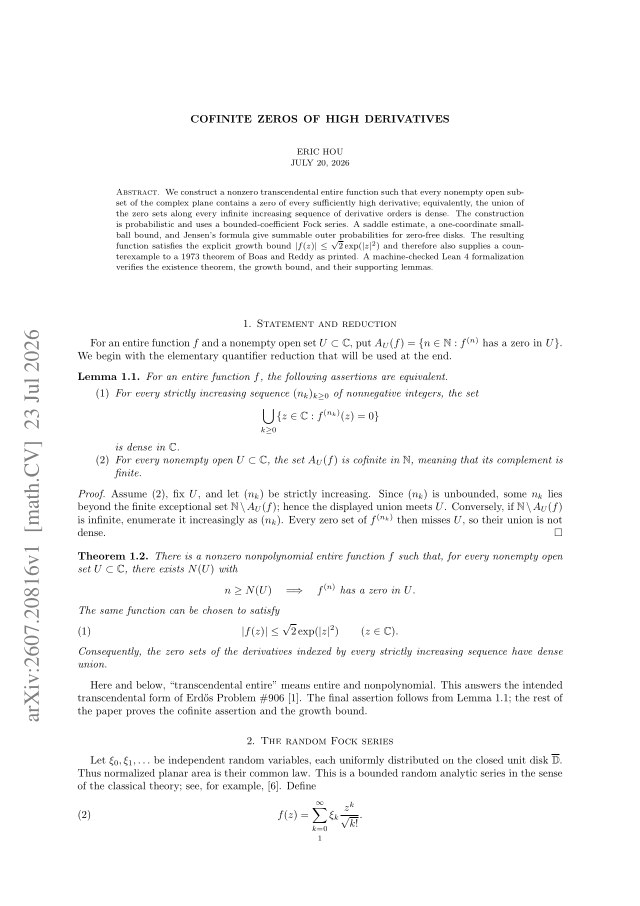
Cofinite Zeros of High Derivatives
Erdős Problem #906 asks whether there is a transcendental entire function whose derivative zeros are eventually dense in every open set. A related 1973 Boas–Reddy theorem asserts the opposite for order-at-most-2 finite-type functions.
A nonzero transcendental entire function is constructed as a bounded-coefficient random Fock series with coefficients uniform on the unit disk. Saddle estimates, a one-coordinate small-ball bound, and Jensen's formula yield summable outer probabilities that derivatives have zero-free disks. A Borel–Cantelli-style argument over a countable base gives the cofinite conclusion. A Lean 4 formalization, pinned to Lean 4.28.0 and Mathlib v4.28.0, checks the existence theorem, the growth bound, and supporting lemmas with no sorry, admit, or custom axioms.
Such a function exists satisfying |f(z)| ≤ √2·exp(|z|²), so every sufficiently high derivative has a zero in every nonempty open set, providing a counterexample to Boas–Reddy Theorem 1 as printed. The machine-checked Lean formalization confirms the main theorem and growth bound.