Iterative quantum algorithms for the minimum vertex cover problem based on continuous-time quantum walks
Ruben Pariente Bassa, Finley A. Quinton, Franz G. Fuchs, Pascal Halffmann
quant-ph
Jul 30, 2026 · v1
TL;DR
Parts of the construction, namely the support bookkeeping and a symplectic Pauli step, are machine-checked in a pinned Lean 4 project shipped with the code.
Abstract
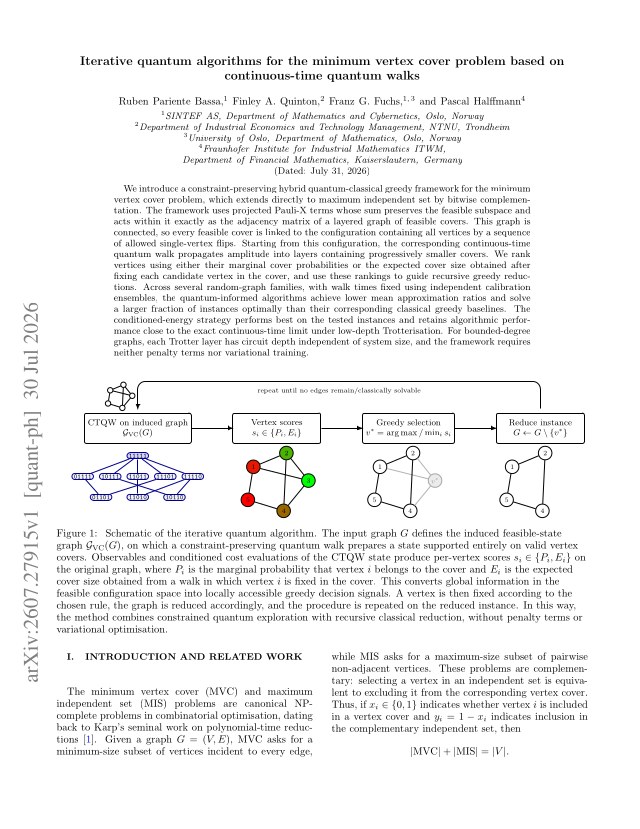
We introduce a constraint-preserving hybrid quantum-classical greedy framework for the minimum vertex cover problem, which extends directly to maximum independent set by bitwise complementation. The framework uses projected Pauli-X terms whose sum preserves the feasible subspace and acts within it exactly as the adjacency matrix of a layered graph of feasible covers. This graph is connected, so every feasible cover is linked to the configuration containing all vertices by a sequence of allowed single-vertex flips. Starting from this configuration, the corresponding continuous-time quantum walk propagates amplitude into layers containing progressively smaller covers. We rank vertices using either their marginal cover probabilities or the expected cover size obtained after fixing each candidate vertex in the cover, and use these rankings to guide recursive greedy reductions. Across several random-graph families, with walk times fixed using independent calibration ensembles, the quantum-informed algorithms achieve lower mean approximation ratios and solve a larger fraction of instances optimally than their corresponding classical greedy baselines. The conditioned-energy strategy performs best on the tested instances and retains algorithmic performance close to the exact continuous-time limit under low-depth Trotterisation. For bounded-degree graphs, each Trotter layer has circuit depth independent of system size, and the framework requires neither penalty terms nor variational training.
Problem
Minimum vertex cover, and by complementation maximum independent set, is NP-hard. Quantum heuristics for it often need penalty terms or variational training.
Approach
Projected Pauli-X terms preserve the feasible subspace and act on it as the adjacency matrix of a connected layered graph of covers. A continuous-time quantum walk starts from the all-vertices cover and propagates amplitude toward smaller covers. Vertices are ranked by marginal cover probability or by conditioned expected cover size, and these rankings guide recursive greedy reductions. Supporting lemmas on support bookkeeping and a symplectic Pauli step are verified in Lean 4.
Results
On several random-graph families, the quantum-informed algorithms achieve lower mean approximation ratios than classical greedy baselines and solve more instances optimally. The conditioned-energy strategy performs best and stays close to the exact continuous-time limit under low-depth Trotterisation. On bounded-degree graphs, each Trotter layer has circuit depth independent of system size.