Modularity of Point Counts for the Curves $X^a=Y^b$: New Rogers–Ramanujan Identities
Kenny Lau, Ken Ono
math.NT
Aug 6, 2026 · v1
math.CO math.RT
TL;DR
AxiomProver verified the newly derived a=3 Rogers–Ramanujan identities in Lean, assuming results from existing literature.
Abstract
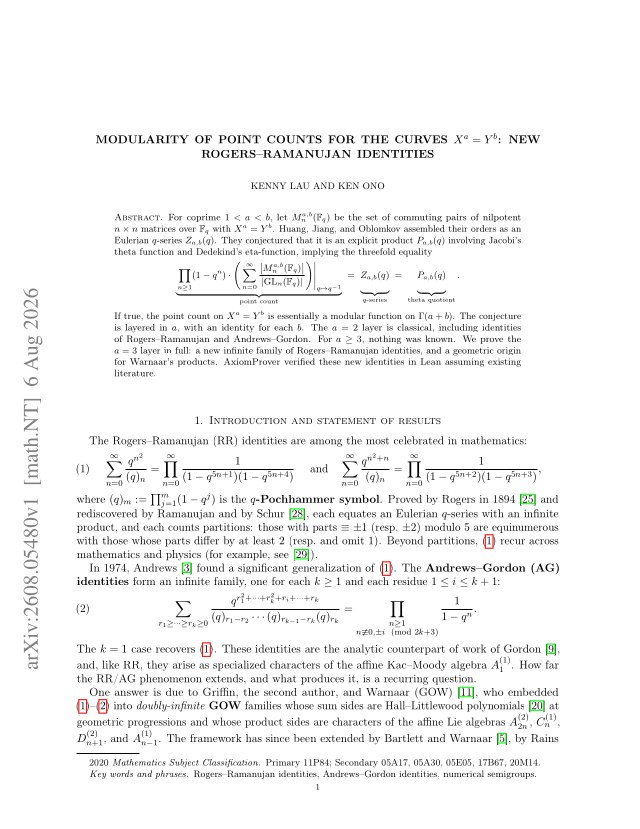
For coprime $1<a<b$, let $M_n^{a,b}(\mathbb{F}_q)$ be the set of commuting pairs of nilpotent $n\times n$ matrices over $\mathbb{F}_q$ with $X^a=Y^b$. Huang, Jiang, and Oblomkov assembled their orders as an Eulerian $q$-series $Z_{a,b}(q)$. They conjectured that it is an explicit product $P_{a,b}(q)$ involving Jacobi's theta function and Dedekind's eta-function, implying the threefold equality $$\underbrace{\prod_{n\ge1}(1-q^n)\cdot\Biggl(\sum_{n=0}^{\infty}\frac{|M_n^{a,b}(\mathbb{F}_q)|}{|\mathrm{GL}_n(\mathbb{F}_q)|}\Biggr)\Biggr|_{q\mapsto q^{-1}}}_{\text{point count}}\;=\;\underbrace{Z_{a,b}(q)}_{q\text{-series}}\;=\;\underbrace{P_{a,b}(q)}_{\text{theta quotient}}$$ If true, the point count on $X^a=Y^b$ is essentially a modular function on $Γ(a+b)$. The conjecture is layered in $a$, with an identity for each $b$. The $a=2$ layer is classical, including identities of Rogers–Ramanujan and Andrews–Gordon. For $a\geq3,$ nothing was known. We prove the $a=3$ layer in full: a new infinite family of Rogers–Ramanujan identities, and a geometric origin for Warnaar's products. AxiomProver verified these new identities in Lean assuming existing literature.
Problem
For coprime 1<a<b, Huang–Jiang–Oblomkov conjectured that the Eulerian q-series Z_{a,b}(q) counting commuting nilpotent matrix pairs with X^a=Y^b equals an explicit theta/eta product, linking point counts to modular functions. The a=2 layer was classical, but nothing was known for a≥3.
Approach
Coordinates are placed on the gap set and fixed-boundary supernomial identities are formulated using Schilling–Warnaar q-supernomial theory. A single fixed-boundary supernomial transformation yields both congruence classes, followed by restoration of boundary summation and passage to Warnaar's A_2 Andrews–Gordon products. The resulting new Rogers–Ramanujan identities were checked with AxiomProver in Lean assuming existing literature.
Results
The a=3 layer of the conjecture is proved in full, giving a new infinite family of Rogers–Ramanujan identities and a geometric origin for Warnaar's products, with the identities verified in Lean.