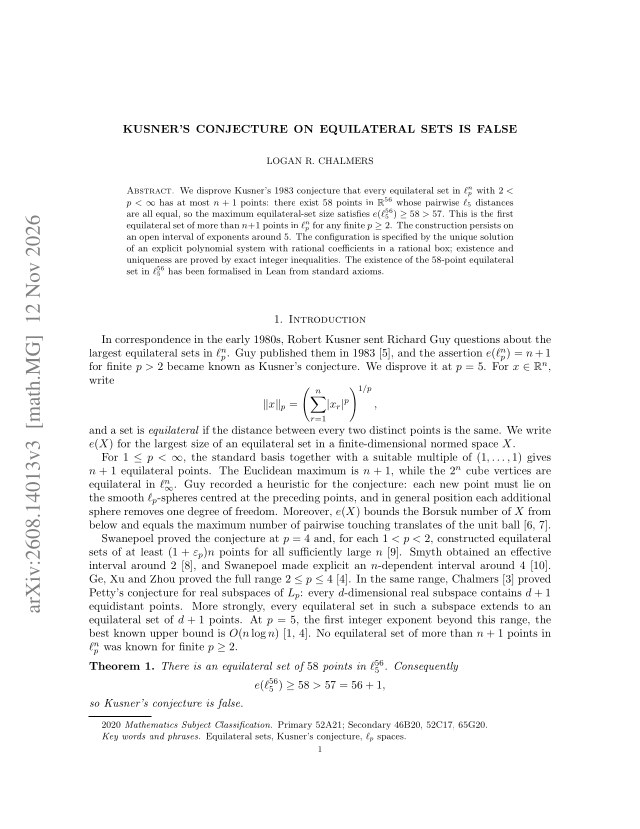
Kusner's conjecture on equilateral sets is false
Logan R. Chalmers
math.MG
Aug 14, 2026 · v3
math.CO math.NA
TL;DR
The existence of a 58-point equilateral set in ℓ5^56 is formalised in Lean, using only standard axioms; the source is released on Zenodo.
Abstract
We disprove Kusner's 1983 conjecture that every equilateral set in $\ell_p^n$ with $2<p<\infty$ has at most $n+1$ points: there exist $58$ points in $\mathbb{R}^{56}$ whose pairwise $\ell_5$ distances are all equal, so the maximum equilateral-set size satisfies $e(\ell_5^{56})\ge58>57$. This is the first equilateral set of more than $n+1$ points in $\ell_p^n$ for any finite $p\ge2$. The construction persists on an open interval of exponents around $5$. The configuration is specified by the unique solution of an explicit polynomial system with rational coefficients in a rational box; existence and uniqueness are proved by exact integer inequalities. The existence of the $58$-point equilateral set in $\ell_5^{56}$ has been formalised in Lean from standard axioms.
Problem
Kusner's 1983 conjecture asserts that every equilateral set in ℓ_p^n with 2<p<∞ has at most n+1 points. The conjecture was known to hold for 2≤p≤4 and was open at p=5.
Approach
The configuration is specified as the unique zero of an explicit rational polynomial system in a small box around rational centre coordinates. Existence and uniqueness follow from a contraction (Newton–Kantorovich-type) lemma. The lemma's hypotheses are checked by exact integer inequalities on archived certificate arrays. The existence theorem is formalised in Lean, relying only on the axioms propext, Classical.choice and Quot.sound.
Results
There are 58 equilateral points in ℓ5^56, so e(ℓ5^56)≥58>57 and Kusner's conjecture is false. The construction persists on an open interval of p around 5 and lies in a 1596-dimensional real-analytic family. The threshold p_0 at which larger equilateral sets first appear satisfies p_0∈[4,5).