
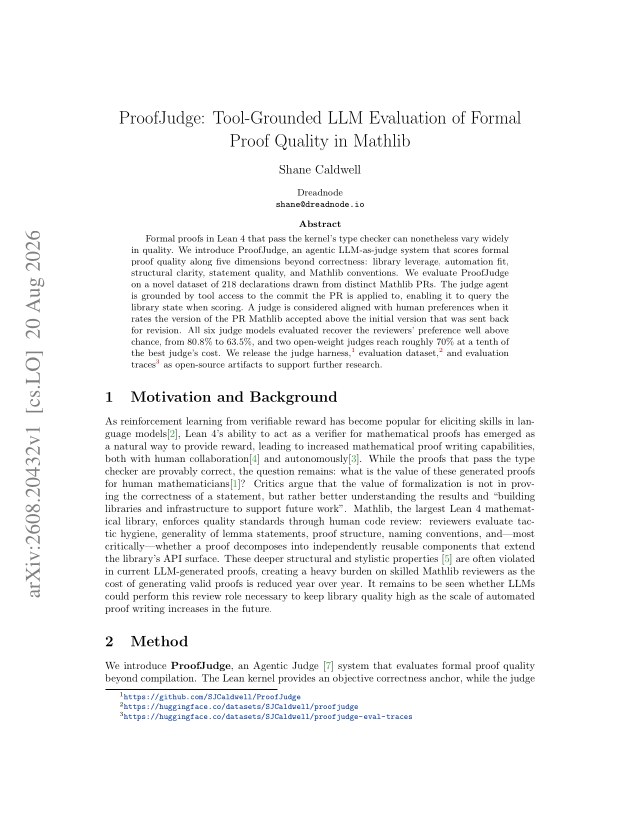
ProofJudge: Tool-Grounded LLM Evaluation of Formal Proof Quality in Mathlib
Formal proofs in Lean 4 that pass the type checker can vary widely in quality along dimensions valued by human mathematicians. As automated proof generation scales, evaluating these qualitative standards places a heavy burden on Mathlib reviewers.
ProofJudge is an agentic LLM-as-judge system that scores formal proof quality along five dimensions beyond correctness: library leverage, automation fit, structural clarity, statement quality, and Mathlib conventions. The judge is grounded via tool access (querying Mathlib through bash) to the commit a PR is applied to. Alignment with human reviewers is measured by whether the judge rates the accepted post-revision version above the rejected pre-revision version.
Evaluated on 218 declaration pairs from distinct Mathlib PRs, all six judge models recovered reviewer preferences above chance, from 80.8% (claude-sonnet-5) to 63.5% (deepseek-v4-flash). Two open-weight judges reached roughly 70% at a tenth of the best judge's cost. Judges were noisy, with verdicts flipping across replicates.
| Judge | Weights | Alignment % (95% CI) | USD/pair |
|---|---|---|---|
| claude-sonnet-5 | closed | 80.8 (73.6–88.2) | 1.392 |
| gemini-3.7-flash | closed | 75.2 (69.3–81.2) | 0.186 |
| muse-glimmer-30b | open | 70.2 (63.4–77.3) | 0.140 |
| gpt-5.4-mini | closed | 68.7 (60.6–77.1) | 0.136 |
| deepseek-v4-flash | open | 63.5 (56.0–71.6) | 0.029 |