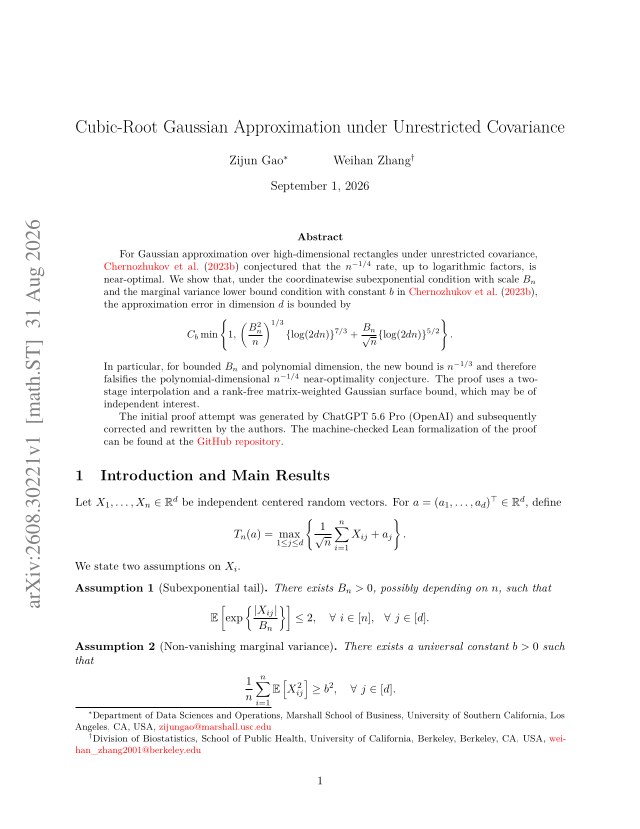
Cubic-Root Gaussian Approximation under Unrestricted Covariance
Zijun Gao, Weihan Zhang
math.ST
Aug 31, 2026 · v1
TL;DR
A Gaussian approximation bound over high-dimensional rectangles is given a machine-checked Lean formalization in an accompanying repository.
Abstract
For Gaussian approximation over high-dimensional rectangles under unrestricted covariance, Chernozhukov et al. (2023b) conjectured that the $n^{-1/4}$ rate, up to logarithmic factors, is near-optimal. We show that, under the coordinatewise subexponential condition with scale $B_n$ and the marginal variance lower bound condition with constant $b$ in Chernozhukov et al. (2023b), the approximation error in dimension $d$ is bounded by \begin{align*} C_b\min\left{ 1,\, \left(\frac{B_n^2}{n}\right)^{1/3}{\log(2dn)}^{7/3} + \frac{B_n}{\sqrt n}{\log(2dn)}^{5/2} \right}. \end{align*} In particular, for bounded $B_n$ and polynomial dimension, the new bound is $n^{-1/3}$ and therefore falsifies the polynomial-dimensional $n^{-1/4}$ near-optimality conjecture. The proof uses a two-stage interpolation and a rank-free matrix-weighted Gaussian surface bound, which may be of independent interest. The initial proof attempt was generated by ChatGPT 5.6 Pro (OpenAI) and subsequently corrected and rewritten by the authors. The machine-checked Lean formalization of the proof can be found at the GitHub repository (
https://github.com/WeihanZhang2001/cubic-root-gaussian-approximation-under-unrestricted-covariance).
Problem
For Gaussian approximation over high-dimensional rectangles under unrestricted covariance, Chernozhukov et al. (2023b) conjectured the n^{-1/4} rate is near-optimal in polynomial dimension. The question is whether a faster rate is achievable under standard subexponential and marginal-variance conditions.
Approach
Under a coordinatewise subexponential condition with scale B_n and a marginal variance lower bound, the approximation error for the max-statistic is bounded. The proof uses truncation/recentering preprocessing, a softmax smoothing of the maximum, a two-stage (third-moment-preserving) path interpolation with an intermediate random vector, and a rank-free matrix-weighted Gaussian surface bound. The initial proof draft was produced by ChatGPT and corrected by the authors, and the proof was formalized and machine-checked in Lean (repository provided).
Results
The approximation error is bounded by C_b min{1,(B_n^2/n)^{1/3}(log 2dn)^{7/3}+(B_n/√n)(log 2dn)^{5/2}}. For bounded B_n and polynomial dimension this gives an n^{-1/3} rate, falsifying the polynomial-dimensional n^{-1/4} near-optimality conjecture.
| Results | Unrestricted covariance | Distribution-free | Rate |
|---|
| Chernozhukov et al. (2017); Koike (2021) | ✓ | ✓ | n^{-1/6} |
| Chernozhukov et al. (2022) | ✓ | ✓ | n^{-1/4} |
| Theorem 1 | ✓ | ✓ | n^{-1/3} |
Comparison of Gaussian approximation rates