
Colombo's Determinant Problem
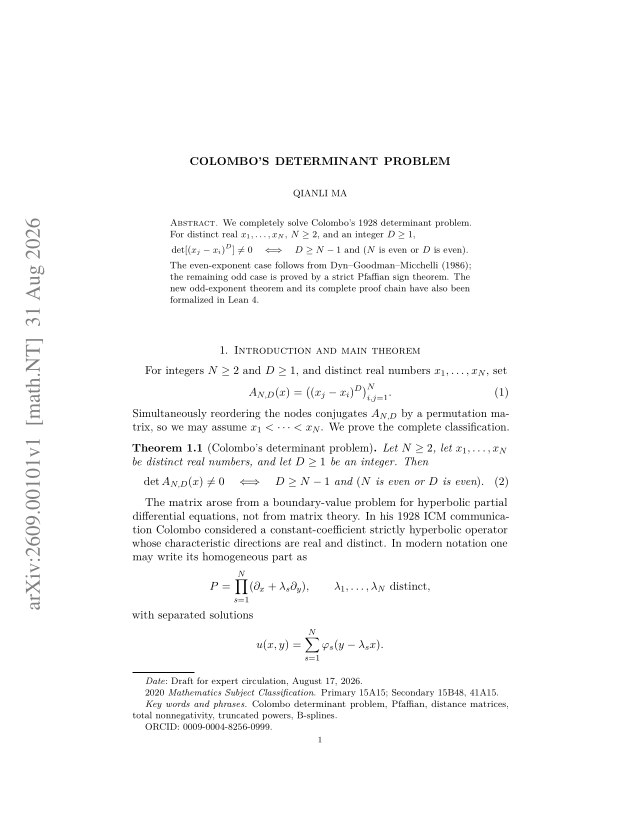
Colombo's 1928 determinant problem asks when det[(x_j-x_i)^D] is nonzero for distinct reals and integer exponent D. The even-exponent case was known, but the odd case remained open.
The paper reduces the odd case to a strict Pfaffian sign theorem, proved via a paired split-determinant inequality established through Marsden's B-spline factorization and total nonnegativity, a Volterra propagation recurrence, and a Beta–de Bruijn integral bridge. Strictness follows from a separated-powers determinant lemma on a central simplex. The complete proof chain for the odd-exponent theorem was formalized in Lean 4.
A complete classification: det[(x_j-x_i)^D] is nonzero iff D >= N-1 and either N or D is even. The odd-exponent strict positivity of the determinant (and positive Pfaffian) is established and machine-verified.