
← All papers
First page of Self-Similar Singularity of the Euler Equations on $\mathbb{R}^3$

Self-Similar Singularity of the Euler Equations on $\mathbb{R}^3$

Adarsh Ganeshram, Valentin Duruisseaux, Anima Anandkumar

math.AP Sep 9, 2026 · v2
Symbolic derivations and algebraic steps of the stability argument are formalized in Lean/Mathlib (github.com/lean-dojo/Euler), with Arb numerical certificates replayed via TorchLean.
We provide evidence of a finite-time singularity in the 3D Euler equations on the unbounded domain. Using a physics-informed neural network (PINN) with a self-similar ansatz, we find an approximate singular profile for the Euler system at the critical blowup rate of $0.5$ and certify it using a spline representation. The transport field associated with the obtained profile has local outgoing property throughout the domain that suggests linear damping, a key stabilizing mechanism for the candidate profile. We also establish a framework for proving nonlinear stability of the approximate self-similar profile, reducing the analysis to a large but finite collection of explicit estimates and computable constants.

Whether the 3D incompressible Euler equations on the unbounded domain R^3 develop a finite-time singularity from smooth data is open. Known blowup results rely on boundaries or non-smooth initial data.

A physics-informed neural network with a self-similar traveling-wave ansatz finds an approximate blowup profile at the critical rate 0.5. Training combines soft and hard constraints, adaptive loss weighting, FP64 arithmetic, boosting, adaptive resampling and curvature-aware optimizers. The profile is converted to splines for certification, and a weighted-energy framework reduces nonlinear stability to a finite set of explicit estimates. Key symbolic derivations are verified in Lean with Mathlib, and Arb interval-arithmetic certificates are replayed in Lean through TorchLean.

A highly accurate approximate profile is obtained, and its transport field is locally outgoing throughout the domain, which suggests linear damping. Low-order damping holds on most of the domain, and high-order damping holds in the problematic off-axis region. The full nonlinear stability proof remains conditional on certifying the remaining constants.
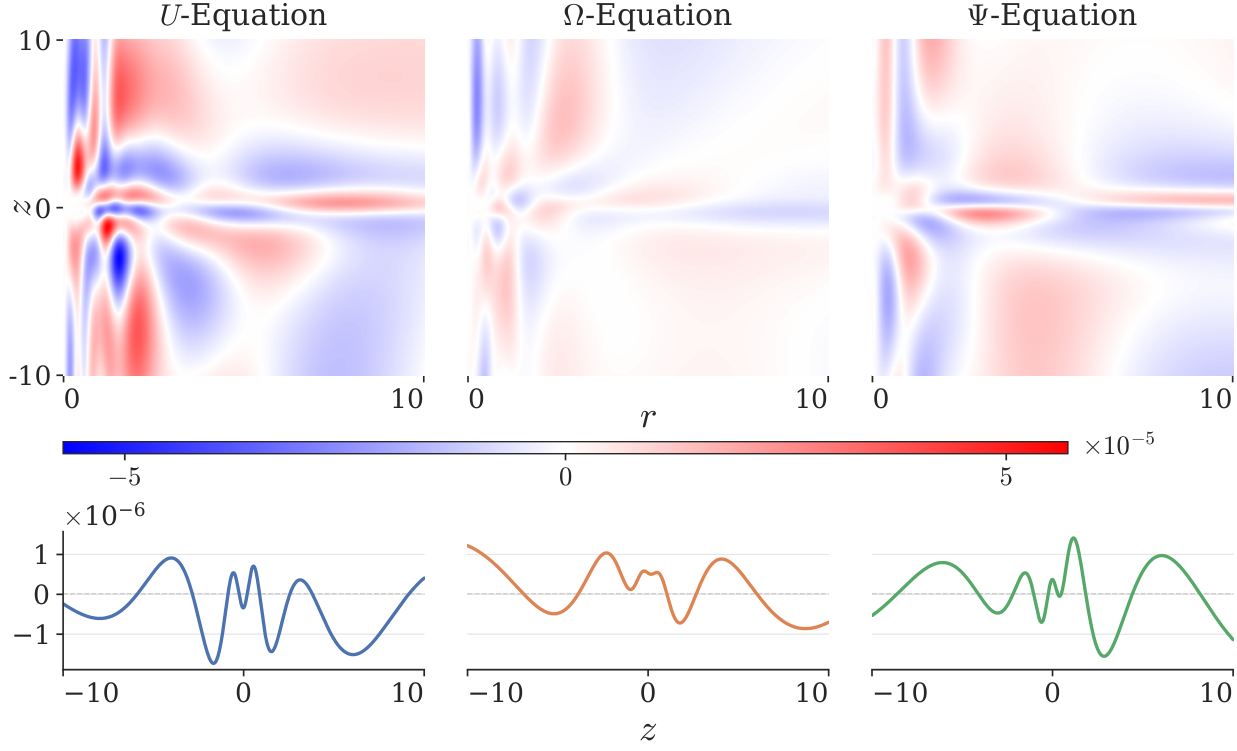
Figure 3 : (Top) Profile equation residuals on the box (r,z)\in[0,10]\times[-10,10] . (Bottom) Profile equation residuals on the symmetry-axis ( r=0 ) with z\in[-10,10] .