Rogers–Ramanujan identities from the geometry of $X^a=Y^b$
Yifeng Huang, Kenny Lau, Ken Ono
math.NT
Sep 17, 2026 · v1
math.AG math.CO math.RT
TL;DR
The finite identity and the HJO conjecture were formalized in Lean by AxiomProver, conditional on two stated literature inputs.
Abstract
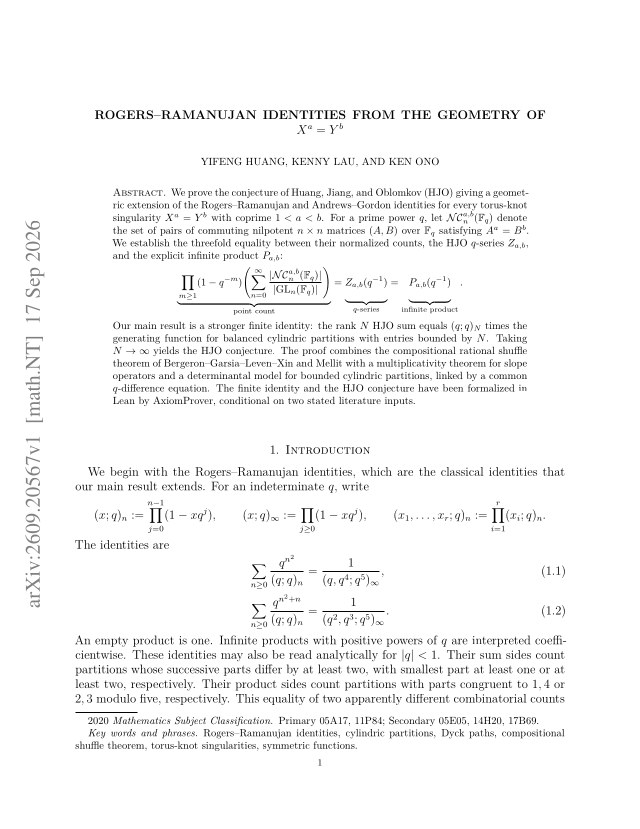
We prove the conjecture of Huang, Jiang, and Oblomkov (HJO) giving a geometric extension of the Rogers–Ramanujan and Andrews–Gordon identities for every torus-knot singularity $X^a=Y^b$ with coprime $1<a<b.$ For a prime power $q$, let $\mathcal{NC}_n^{a,b}(\mathbb F_q)$ denote the set of pairs of commuting nilpotent $n\times n$ matrices $(A,B)$ over $\mathbb F_q$ satisfying $A^a=B^b$. We establish the threefold equality between their normalized counts, the HJO $q$-series $Z_{a,b}$, and the explicit infinite product $P_{a,b}$: \[ \underbrace{\vphantom{\Bigg|} \prod_{m\geq1}(1-q^{-m}) \Biggl(\sum_{n=0}^{\infty} \frac{\lvert\mathcal{NC}_n^{a,b}(\mathbb F_q)\rvert} {\lvert\operatorname{GL}_n(\mathbb F_q)\rvert}\Biggr) }_{\text{point count}} = \underbrace{\vphantom{\Bigg|}Z_{a,b}(q^{-1}) }_{\text{\(q\)-series}} = \underbrace{\vphantom{\Bigg|}P_{a,b}(q^{-1}) }_{\text{infinite product}}. \] Our main result is a stronger finite identity: the rank $N$ HJO sum equals $(q;q)_N$ times the generating function for balanced cylindric partitions with entries bounded by $N$. Taking $N\to\infty$ yields the HJO conjecture. The proof combines the compositional rational shuffle theorem of Bergeron–Garsia–Leven–Xin and Mellit with a multiplicativity theorem for slope operators and a determinantal model for bounded cylindric partitions, linked by a common $q$-difference equation. The finite identity and the HJO conjecture have been formalized in Lean by AxiomProver, conditional on two stated literature inputs.
Problem
The Huang–Jiang–Oblomkov conjecture gives a geometric extension of the Rogers–Ramanujan and Andrews–Gordon identities for every torus-knot singularity X^a=Y^b with coprime 1<a<b. The goal is to prove this conjecture by establishing a threefold equality between point counts of commuting nilpotent matrices, the HJO q-series, and an explicit infinite product.
Approach
A stronger finite identity is proven: the rank-N HJO sum equals (q;q)_N times the generating function for balanced cylindric partitions with entries bounded by N. The proof combines the compositional rational shuffle theorem of Bergeron–Garsia–Leven–Xin and Mellit with a multiplicativity theorem for slope operators and a determinantal model for bounded cylindric partitions, linked by a common q-difference equation. Taking N to infinity yields the HJO conjecture. The finite identity and the HJO conjecture were formalized in Lean by AxiomProver, conditional on two stated literature inputs.
Results
The threefold equality between the normalized point counts, the HJO q-series Z_{a,b}, and the infinite product P_{a,b} is established, proving the HJO conjecture for all coprime 1<a<b.