
The Zygmund conjecture and Rey's exponential integrability conjecture
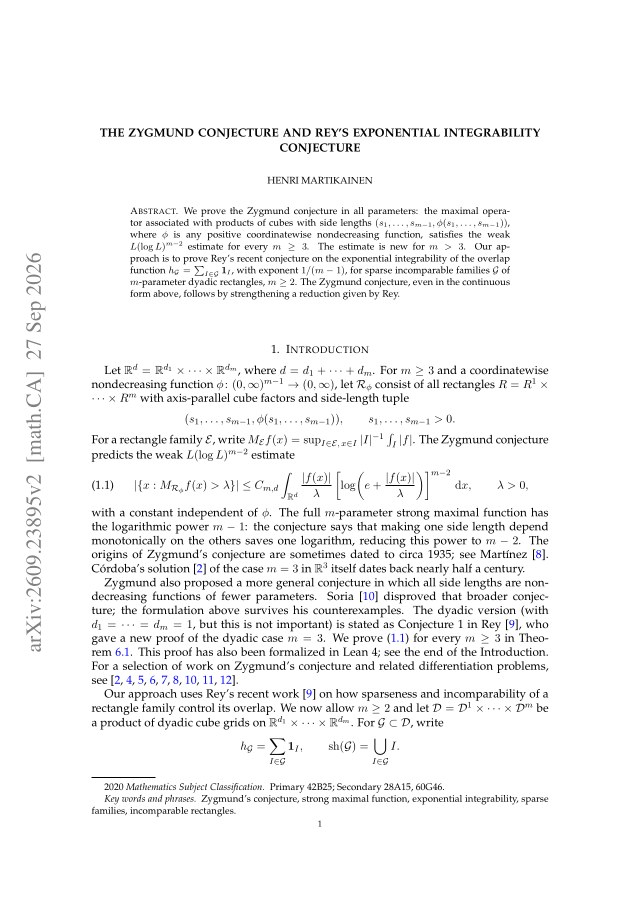
The Zygmund conjecture asks whether the maximal operator over products of cubes, with the last side length a nondecreasing function of the others, satisfies a weak L(log L)^{m-2} estimate. Before this work the estimate was known only for m=3. A related conjecture of Rey concerns exponential integrability of the overlap function of sparse incomparable families of dyadic rectangles.
Rey's conjecture is proved with exponent 1/(m-1) via an incomparable maximal estimate with constant (p')^{m-1}. The proof uses a product maximal square-function estimate, a projection representing averages through at most m-1 coordinates, and weighted square-function bounds. A strengthened version of Rey's reduction then yields the continuous Zygmund estimate. The results are formalized in Lean 4; the main codebase was produced with an AI model working through specialized subagents.
The Zygmund conjecture is proved for all m≥3, and the bound is new for m>3. The exponent 1/(m-1) for sparse Φ-Zygmund families is shown to be sharp even under incomparability. Seven main results are formalized against independent Mathlib-only statements, confirmed by Comparator, and checked by Lean's kernel and Nanoda.
| Setting | Sparse | Sparse and incomparable |
|---|---|---|
| Bi-parameter | 1/2 | 1 (Rey's theorem) |
| m-parameter, m≥3 | 1/m | 1/(m-1) (this paper) |