
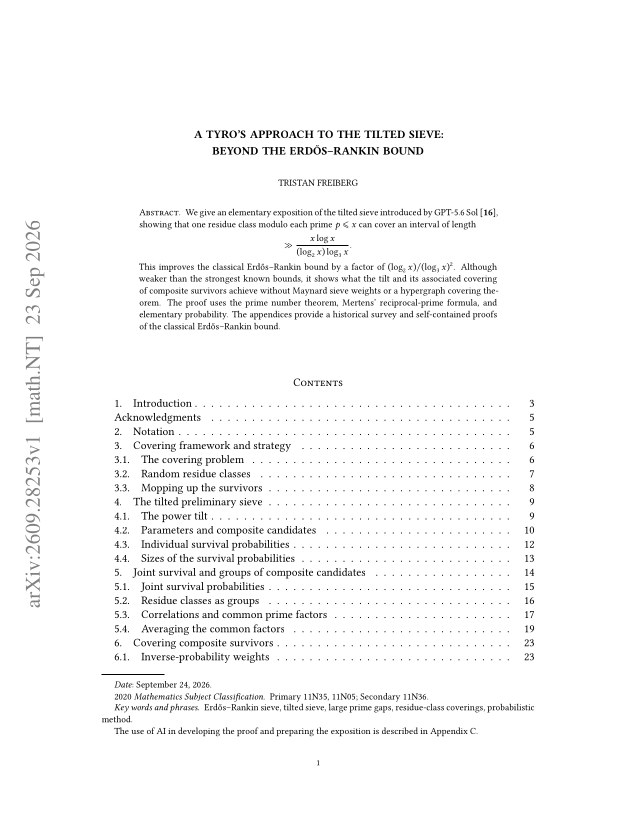
A tyro's approach to the tilted sieve: beyond the Erdős–Rankin bound
The covering function Y(x) measures how long an interval can be covered by one residue class modulo each prime p ≤ x, and it controls large gaps between primes. The paper asks how much of the recent tilted-sieve improvement over the Erdős–Rankin bound survives without Maynard sieve weights or a hypergraph covering theorem.
A preliminary sieve uses tilted distributions: the probability of the zero class varies with the prime, so that the survival probability of a squarefree rough integer depends only on its size. Composite survivors are covered in groups, one residue class modulo a reserve prime at a time, using inverse-probability weights. Joint survival is controlled through greatest common divisors. The remaining survivors are covered by mopping primes. The only external inputs are the prime number theorem, Mertens' formula and elementary probability.
The proof gives Y(x) ≫ x log x / ((log_2 x) log_3 x), improving Erdős–Rankin by a factor (log_2 x)/(log_3 x)^2. As a corollary, the largest prime gap satisfies G(X) ≫ (log X)(log_2 X)/((log_3 X) log_4 X). A Lean 4 formalization is referenced.
| Source | Bound on Y(x) |
|---|---|
| This paper | x log x / ((log_2 x) log_3 x) |
| FGKMT 2018 | x (log x) log_3 x / log_2 x |
| GPT-5.6 Sol 2026 | x log x / log_3 x |