Greedy queens and the golden ratio
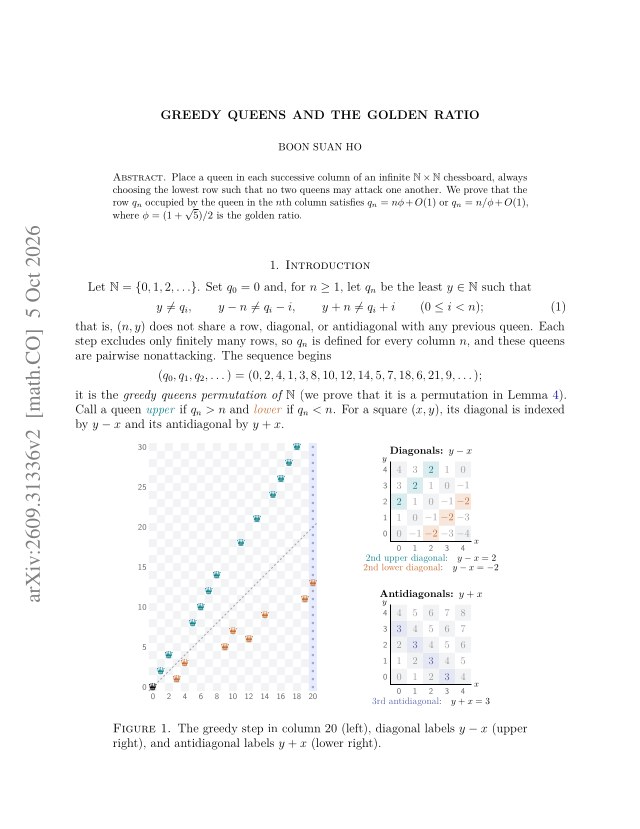
Greedy queens place a queen in each column of an infinite N×N board at the lowest non-attacked row. Dekking, Shallit, and Sloane conjectured that the queen positions stay within bounded distance of the lines y=xφ and y=x/φ.
The k-th upper queen is shown to lie on the k-th upper diagonal, and the conjecture is reduced to a bounded diagonal discrepancy |d_j−j|≤4 for lower queens. The process is modelled by finite local states (records) that are shown to determine each greedy step. A computer check confirms that the reachable states form a finite graph satisfying the required bounds, and induction extends this to all columns. Code and a Lean formalization are released.
For upper queens, |q_n−nφ|<5/φ. For lower queens, |q_n−n/φ|<4+5/φ, which proves the conjecture. Sharper explicit bounds are also given, along with an O(N)-time, O(log N)-memory generator that uses under 2 MiB for ten billion queens.