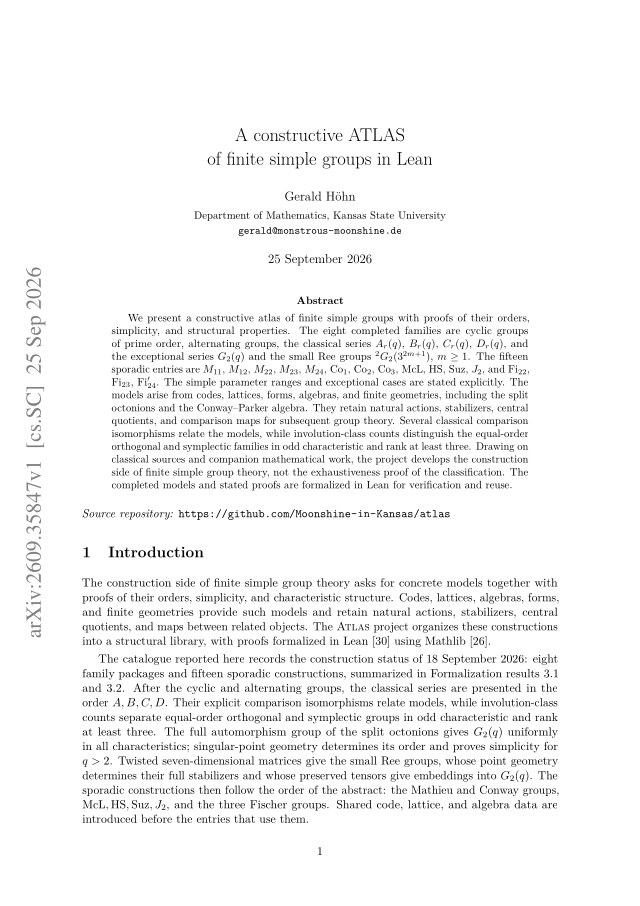
A constructive ATLAS of finite simple groups in Lean
Gerald Höhn
cs.SC
Sep 25, 2026 · v1
cs.LO math.GR
TL;DR
Formalizes in Lean with Mathlib concrete constructions of finite simple groups, proving their orders, simplicity, and structural properties.
Abstract
We present a constructive atlas of finite simple groups with proofs of their orders, simplicity, and structural properties. The eight completed families are cyclic groups of prime order, alternating groups, the classical series $A_r(q)$, $B_r(q)$, $C_r(q)$, $D_r(q)$, and the exceptional series $G_2(q)$ and the small Ree groups $ {}^2G_2(3^{2m+1})$, $m\geq1$. The fifteen sporadic entries are $M_{11}$, $M_{12}$, $M_{22}$, $M_{23}$, $M_{24}$, $\mathrm{Co}_1$, $\mathrm{Co}_2$, $\mathrm{Co}_3$, $\mathrm{McL}$, $\mathrm{HS}$, $\mathrm{Suz}$, $J_2$, and $\mathrm{Fi}_{22}$, $\mathrm{Fi}_{23}$, $\mathrm{Fi}_{24}'$. The simple parameter ranges and exceptional cases are stated explicitly. The models arise from codes, lattices, forms, algebras, and finite geometries, including the split octonions and the Conway–Parker algebra. They retain natural actions, stabilizers, central quotients, and comparison maps for subsequent group theory. Several classical comparison isomorphisms relate the models, while involution-class counts distinguish the equal-order orthogonal and symplectic families in odd characteristic and rank at least three. Drawing on classical sources and companion mathematical work, the project develops the construction side of finite simple group theory, not the exhaustiveness proof of the classification. The completed models and stated proofs are formalized in Lean for verification and reuse.
Problem
The construction side of finite simple group theory requires concrete models of the groups, with proofs of their orders, simplicity, and characteristic structure. This is separate from the exhaustiveness part of the classification.
Approach
The groups are built from codes, lattices, quadratic and symplectic forms, algebras such as the split octonions and the Conway–Parker algebra, and finite geometries. Each entry is a defined group with proofs of its order and simplicity, plus independently defined structure: actions, stabilizers, central quotients, and comparison maps. Involution-class counts separate equal-order orthogonal and symplectic groups in odd characteristic and rank at least three. All completed models and proofs are formalized in Lean using Mathlib.
Results
Eight family packages are completed: cyclic groups of prime order, alternating groups, A_r(q), B_r(q), C_r(q), D_r(q), G_2(q), and the small Ree groups. Fifteen sporadic groups are also constructed, including the Mathieu, Conway, and Fischer groups, McL, HS, Suz, and J_2. Simplicity exceptions are stated explicitly, and several comparison isomorphisms between the models are proved.
| Group | Order | Chosen construction |
|---|
| M_24 | 244,823,040 | Full binary Golay code automorphism group |
| Co_1 | 4,157,776,806,543,360,000 | Leech isometry group modulo {±I} |
| Co_2 | 42,305,421,312,000 | Stabilizer of a Leech vector of squared norm 4 |
| Co_3 | 495,766,656,000 | Stabilizer of a Leech vector of squared norm 6 |
Selected sporadic constructions (partial transcription)