Builds an LLM pipeline that autoformalizes students' natural-language linear algebra proofs into Lean with Mathlib, compiles them, and informalizes the verifier feedback.
Abstract
Large language models are increasingly used as collaborators on deductive-reasoning tasks, but their outputs can hallucinate or pull users away from intended reasoning. Formal proof assistants provide machine-checked verification, but have a steep learning curve and require more granular reasoning than human written proofs. We explore an interface that combines these strengths, allowing users to write and revise free-form natural-language proofs while a verified backend checks their reasoning and returns feedback at the user's granularity. We study this interface in the context of undergraduate mathematics education by developing LeanSide, a formally verified co-reasoning system, which auto-formalizes student reasoning into Lean and informalizes verifier output into understandable feedback. We conducted user studies through classroom deployment and analyzed which system properties helped students make progress and which caused them to get stuck. We use these findings to derive design implications for using a formally verified backend in human-AI co-reasoning systems.
Problem
LLM collaborators on proofs can hallucinate, while formal proof assistants are hard for novices and demand more granular reasoning than people normally write. Undergraduates need verified feedback on free-form proofs that is faithful to their own reasoning path.
Approach
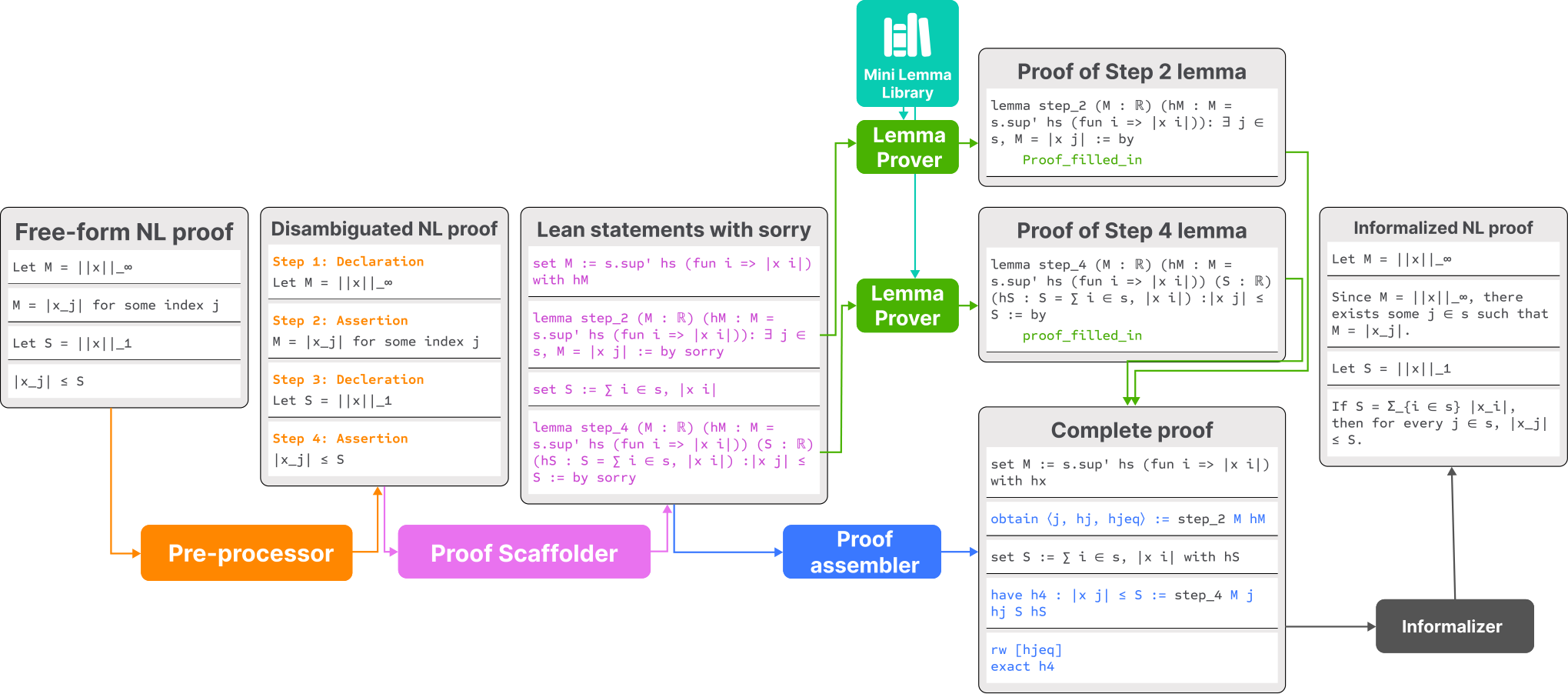
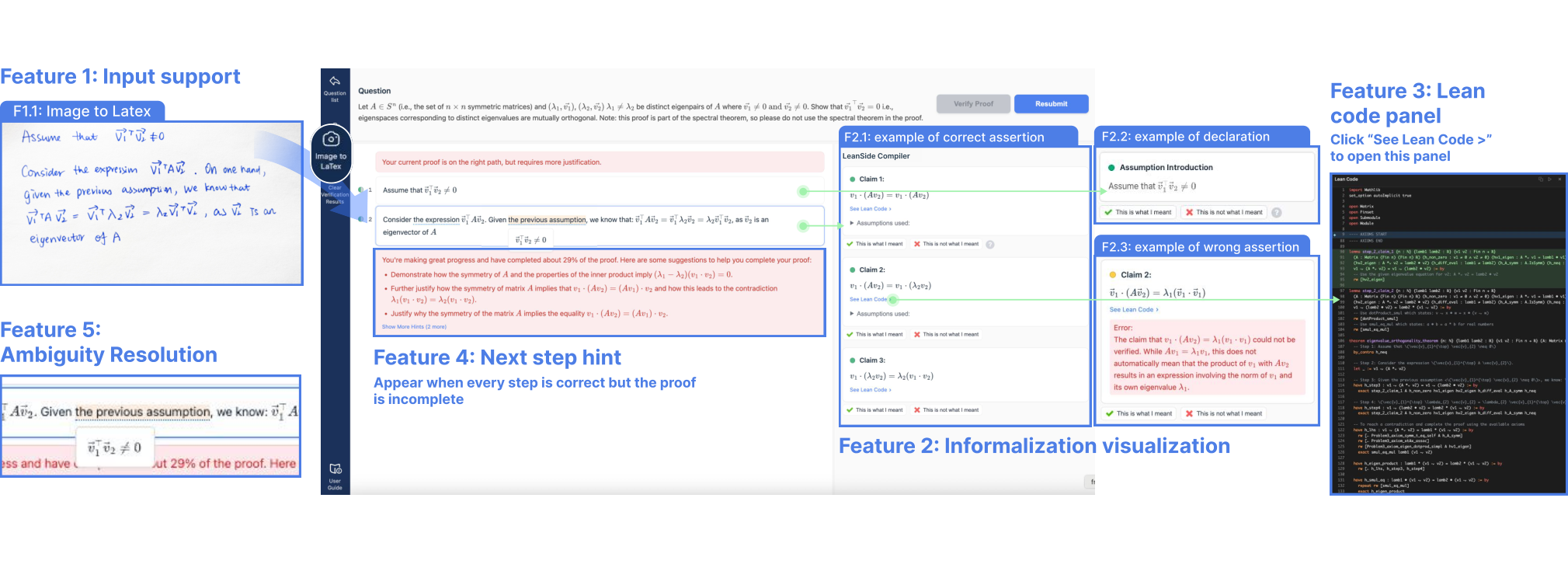
LeanSide accepts handwritten or LaTeX proofs and passes them through LLM-based modules: a natural-language pre-processor, a proof scaffolder, and a prover with a lemma prover and proof assembler. These modules autoformalize each step into Lean, supported by Mathlib and a mini lemma library. Compiler output is then informalized into step-level natural-language feedback. The system was deployed in an undergraduate linear algebra course across 14 problems, and experts reviewed the generated Lean code and the system's judgments.
Figure 4. This figure shows the system pipeline. Student input (left) is auto-formalized into Lean through the pre-processor, proof scaffolder and prover, which includes the lemma prover and proof assembler. The generated Lean code and error messages are then informalized back into natural language. The mini-lemma library supports the lemma prover.Figure 3. The User Interface. Students use the system by uploading handwritten proofs, or typing in. In this snapshot, a student has already uploaded an image of their proof and completed the verification process. The resulting feedback is displayed.
Results
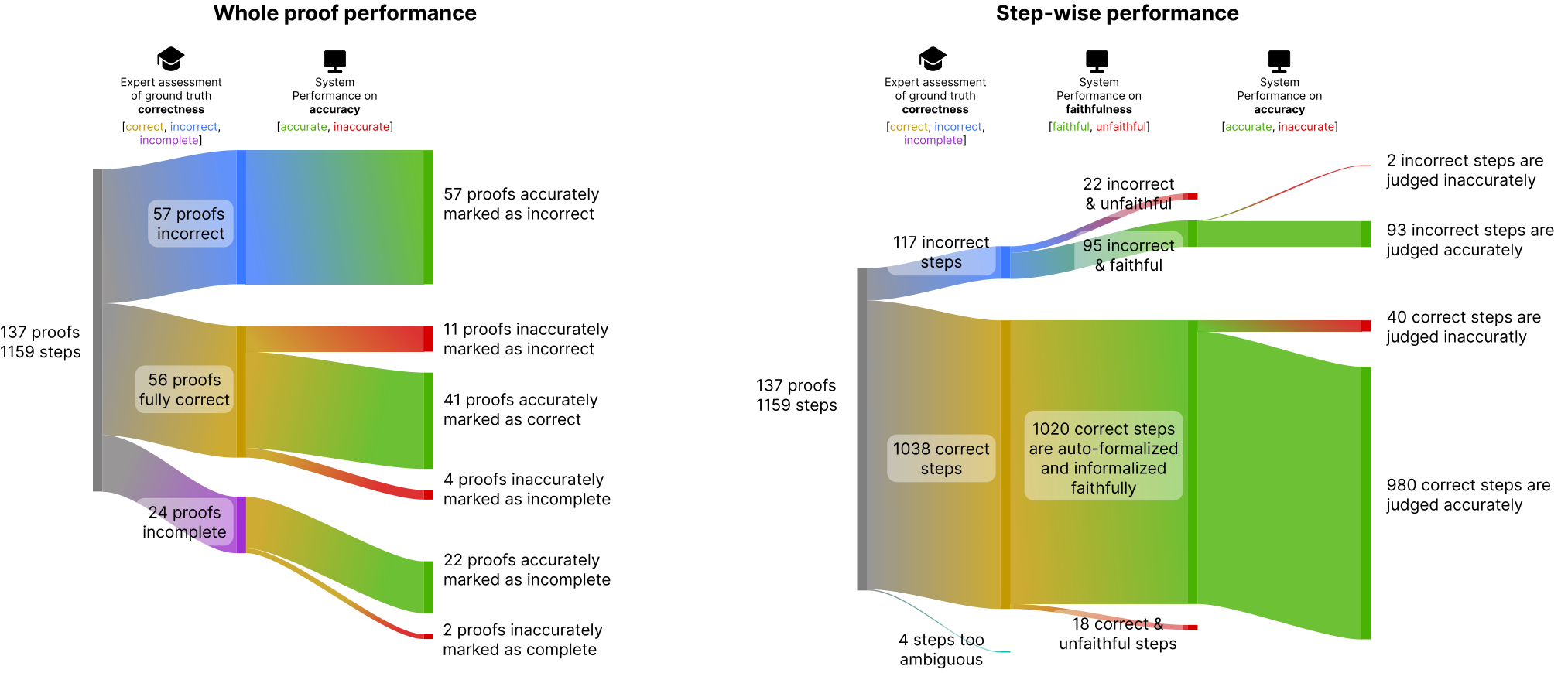
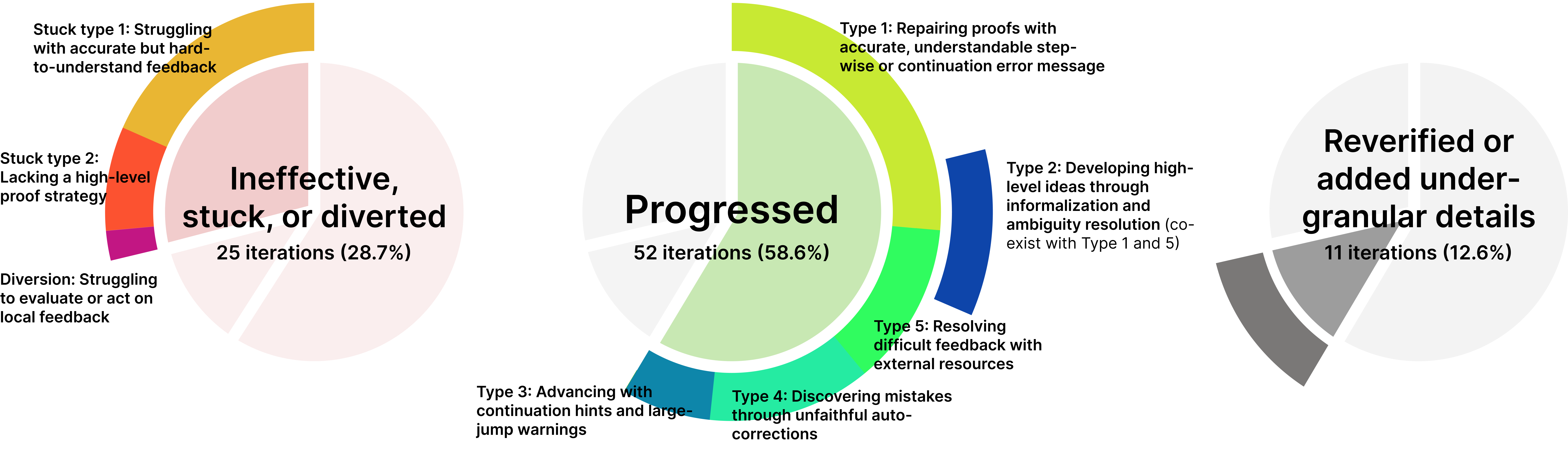
Across 137 proofs and 1,038 correct plus 117 incorrect expert-labeled steps, 2% of correct steps and 18% of incorrect steps were unfaithfully formalized. The system rarely accepted flawed proofs, but flagged 20% of fully correct proofs as containing an error. Students agreed with experts on faithfulness and accuracy judgments 83–99% of the time, and 58% of revision iterations led to progress.
Figure 6. This figure shows the system’s faithfulness and accuracy performance: the left side shows whole-proof performance, and the right side shows step-level performance. We use correct and incorrect for expert-assessed ground truth, accurate and inaccurate for whether the system’s judgment matches that ground truth, and faithful and unfaithful for whether auto-formalization preserves the studeFigure 7. Distribution of coded revision outcomes. Most iterations led to progress (52 iterations, 58.6%), while 25 iterations (28.7%) were not useful, involved getting stuck, or diverted students from productive proof paths, and 11 iterations (12.6%) involved reverifying or adding under-granular details. The labels show the progress and breakdown types analyzed in this section.