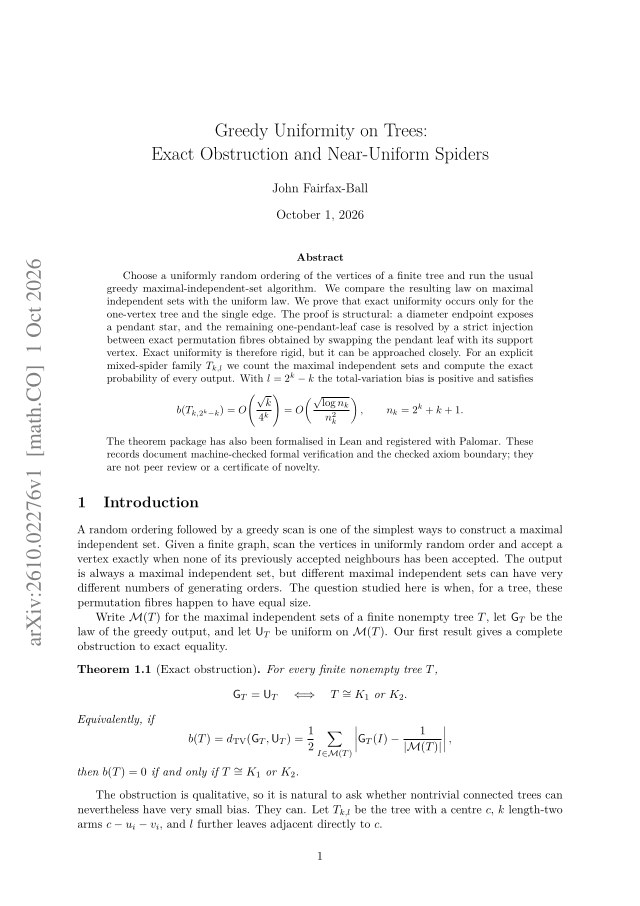
Greedy Uniformity on Trees: Exact Obstruction and Near-Uniform Spiders
John Fairfax-Ball
math.CO
Oct 1, 2026 · v1
math.PR
TL;DR
The exact-obstruction theorem and the mixed-spider bias results are formalised in Lean 4 with Mathlib and registered with Palomar, using only standard axioms.
Abstract
Choose a uniformly random ordering of the vertices of a finite tree and run the usual greedy maximal-independent-set algorithm. We compare the resulting law on maximal independent sets with the uniform law. We prove that exact uniformity occurs only for the one-vertex tree and the single edge. The proof is structural: a diameter endpoint exposes a pendant star, and the remaining one-pendant-leaf case is resolved by a strict injection between exact permutation fibres obtained by swapping the pendant leaf with its support vertex. Exact uniformity is therefore rigid, but it can be approached closely. For an explicit mixed-spider family $T_{k,l}$ we count the maximal independent sets and compute the exact probability of every output. With $l=2^k-k$ the total-variation bias is positive and satisfies [ b(T_{k,2^k-k})=O!\left(\frac{\sqrt{k}}{4^k}\right) =O!\left(\frac{\sqrt{\log n_k}}{n_k^2}\right), \qquad n_k=2^k+k+1. ] The theorem package has also been formalised in Lean and registered with Palomar. These records document machine-checked formal verification and the checked axiom boundary; they are not peer review or a certificate of novelty.
Problem
Running greedy maximal-independent-set selection under a uniformly random vertex order on a finite tree induces a law on maximal independent sets. The question is when this law equals the uniform law, and how close to uniform it can get.
Approach
A structural proof uses a diameter endpoint to expose a pendant star. Pendant stars with two or more leaves are handled by comparing selection probabilities with a counting bound on maximal independent sets. The one-pendant-leaf case is handled by a strict injection between permutation fibres that swaps the leaf with its support vertex. For mixed spiders T_{k,l}, exact output probabilities are computed, and the bias is tuned with l=2^k-k and bounded using a binomial expectation identity; all results are formalised in Lean 4 with Mathlib.
Results
Exact uniformity holds only for K1 and K2. The tuned mixed spiders have positive bias O(sqrt(k)/4^k) = O(sqrt(log n)/n^2). Nine final theorem declarations are machine-checked in Lean using only propext, Classical.choice and Quot.sound, and are registered with Palomar.
| k | l | \ | V\ | | b(T) |
|---|
| 2 | 2 | 7 | 1/30 |
| 3 | 5 | 12 | 7/576 |
| 4 | 12 | 21 | 41/13260 |
| 6 | 58 | 71 | 18353/78602160 |
Selected exact biases for T_{k,2^k-k}