Large deviations of the spectral radius of iid subgaussian random matrices
Yi Han
math.PR
Oct 4, 2026 · v2
TL;DR
The paper's results on spectral-radius large deviations are formalized in Lean, with repositories released, including one for the upper-tail bounds.
Abstract
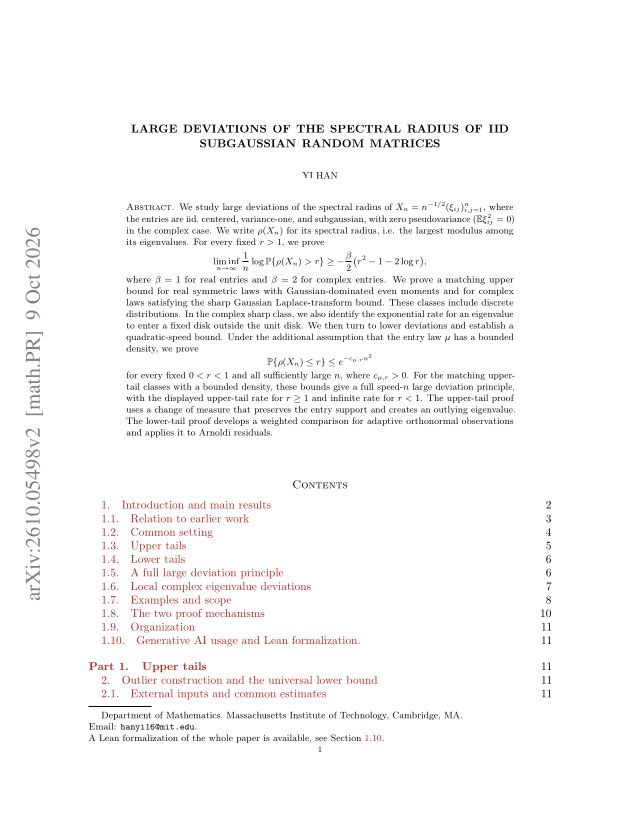
We study large deviations of the spectral radius of $X_n=n^{-1/2}(ξ_{ij})_{i,j=1}^n$, where the entries are iid, centered, variance-one, and subgaussian, with zero pseudovariance in the complex case. We write $ρ(X_n)$ for its spectral radius, i.e. the largest modulus among its eigenvalues. For every fixed $r>1$, we prove $$ \liminf_{n\to\infty}\frac1n\log\mathbb{P}\{ρ(X_n)>r\} \ge -\frac\beta2\bigl(r^2-1-2\log r\bigr), $$ where $β=1$ for real entries and $β=2$ for complex entries. We prove a matching upper bound for real symmetric laws with Gaussian-dominated even moments and for complex laws satisfying the sharp Gaussian Laplace-transform bound. These classes include discrete distributions. In the complex sharp class, we also identify the exponential rate for an eigenvalue to enter a fixed disk outside the unit disk. We then turn to lower deviations and establish a quadratic-speed bound. Under the additional assumption that the entry law $μ$ has a bounded density, we prove $$ \mathbb{P}\{ρ(X_n)\le r\}\le e^{-c_{μ,r}n^2} $$ for every fixed $0<r<1$ and all sufficiently large $n$, where $c_{μ,r}>0$. For the matching upper-tail classes with a bounded density, these bounds give a full speed-$n$ large deviation principle, with the displayed upper-tail rate for $r\ge1$ and infinite rate for $r<1$. The upper-tail proof uses a change of measure that preserves the entry support and creates an outlying eigenvalue. The lower-tail proof develops a weighted comparison for adaptive orthonormal observations and applies it to Arnoldi residuals.
Problem
The paper studies fixed-radius large deviations of the spectral radius of iid subgaussian random matrices, real or complex, normalized by n^{-1/2}. This extends earlier Ginibre-only large deviation principles to non-Gaussian entries, including discrete laws.
Approach
For the upper tail, a change of measure that preserves the entry support creates an outlying eigenvalue. Matching upper bounds come from full-sphere integrals in the complex sharp-subgaussian case and from moment comparison with Ginibre matrices in the real case. For the lower tail, a weighted comparison for adaptive orthonormal observations is applied to Arnoldi residuals. The whole paper is formalized in Lean.
Results
A universal speed-n lower bound with rate (β/2)(r²−1−2 log r) holds for r>1, with matching upper bounds for the classes described above. For entries with a bounded density, P{ρ≤r}≤e^{-cn²} for 0<r<1, which yields a full large deviation principle. The Lean formalization is reported as complete.