Gluons and Knots
Alfredo Guevara
hep-th
Oct 7, 2026 · v1
TL;DR
The knot state-sum formula for the single-minus gluon amplitude is formalized and verified in a Lean 4 library, with an explicit assumption dependency graph.
Abstract
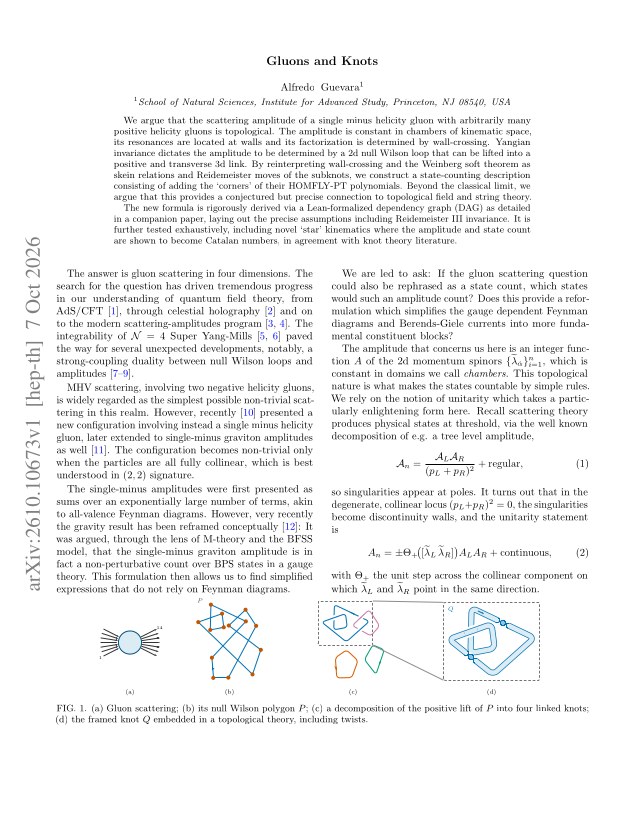
We argue that the scattering amplitude of a single minus helicity gluon with arbitrarily many positive helicity gluons is topological. The amplitude is constant in chambers of kinematic space, its resonances are located at walls and its factorization is determined by wall-crossing. Yangian invariance dictates the amplitude to be determined by a 2d null Wilson loop that can be lifted into a positive and transverse 3d link. By reinterpreting wall-crossing and the Weinberg soft theorem as skein relations and Reidemeister moves of the subknots, we construct a state-counting description consisting of adding the `corners' of their HOMFLY-PT polynomials. Beyond the classical limit, we argue that this provides a conjectured but precise connection to topological field and string theory. The new formula is rigorously derived via a Lean-formalized dependency graph (DAG) as detailed in a companion paper, laying out the precise assumptions including Reidemeister III invariance. It is further tested exhaustively, including novel `star' kinematics where the amplitude and state count are shown to become Catalan numbers, in agreement with knot theory literature.
Problem
The tree amplitude of one minus-helicity gluon with many positive-helicity gluons is piecewise constant in kinematic space. The goal is a topological description of it in terms of knots and an explanation of its wall-crossing factorization.
Approach
The amplitude is expressed through a 2d null Wilson-loop polygon with chirotope coordinates. Wall-crossing laws and the Weinberg soft theorem are derived and shown to determine the amplitude uniquely from the triangle. A state sum over decompositions of the positive 3d lift of the polygon is built from corner coefficients of HOMFLY-PT polynomials. Skein relations and Reidemeister moves are used to show that the state sum satisfies the same laws, with the formal proof and its dependency graph carried out in a Lean 4 library.
Results
The state sum equals the amplitude for generic polygons, under stated assumptions that include Reidemeister III invariance. For 'star' kinematics, both the amplitude and the state count equal signed Catalan numbers, (-1)^r Cat_r.