
Anomalous scaling limit of a Brownian particle in a log-correlated potential
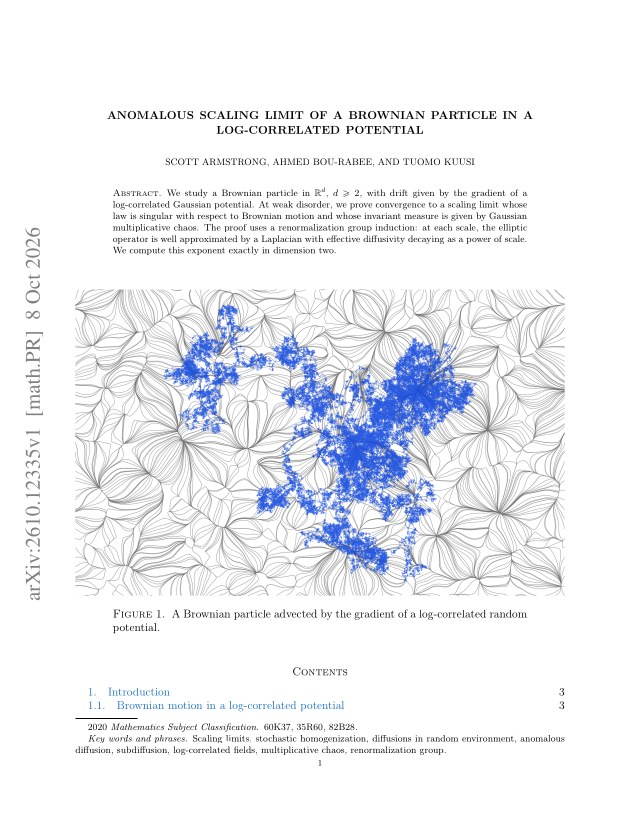
The paper studies the long-time behavior of a Brownian particle in R^d, d≥2, whose drift is the gradient of a log-correlated Gaussian potential. Effective diffusivity vanishes on large scales, so the particle is subdiffusive.
A renormalization group induction over scales uses coarse-grained matrices from Armstrong–Kuusi. At each scale the elliptic operator is approximated by a Laplacian with effective diffusivity decaying as a power of scale. Large-scale regularity, Dirichlet homogenization and a uniqueness argument for limiting Dirichlet forms are used to construct the scaling limit. Theorems A–C and their supporting results were formalized and machine-checked in Lean 4.
At weak disorder, the rescaled process converges to a scaling limit whose law is singular with respect to Brownian motion, with Gaussian multiplicative chaos as invariant measure. In dimension two the diffusivity exponent is computed exactly via the identity ā_m = e^{-τ²(m+1)}.