
A Four-by-Four Obstruction to Polynomial Removal for Ordered Binary Matrices
Whether a fixed small binary pattern matrix can fail to admit a polynomial induced ordered removal bound. The earlier known obstruction used a 66x66 pattern.
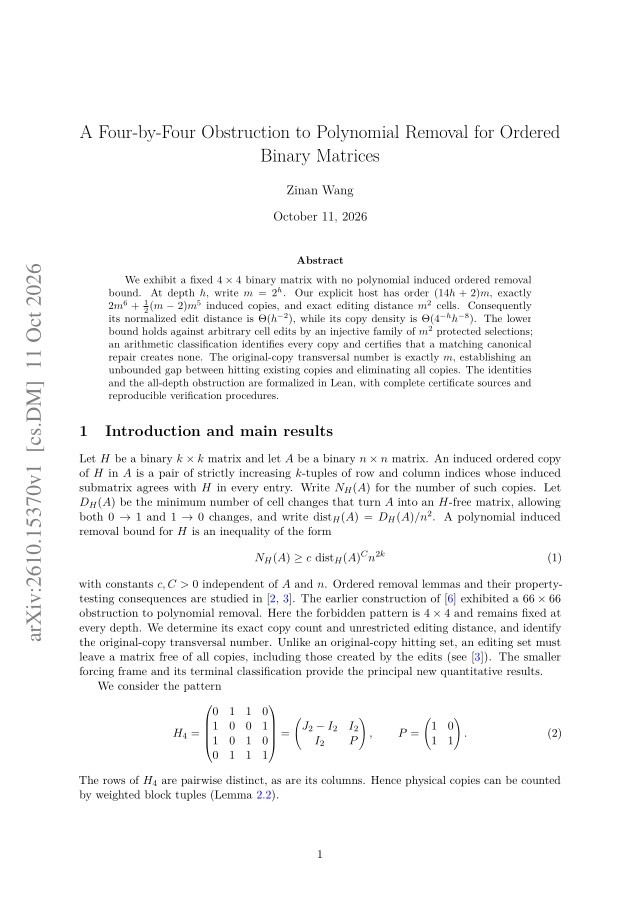
An explicit host matrix A_h of order (14h+2)2^h is built from binary trees of row and column blocks, marker modes and dummy blocks, with block-constant entries. An injective family of m^2 protected selections gives a lower bound on edit distance against arbitrary cell edits. An exhaustive arithmetic classification shows every induced copy of the 4x4 pattern H_4 falls into one of two terminal families, and a canonical repair is shown to be copy-free. All identities and the obstruction at every depth are machine-checked in Lean 4.24.0 with a pinned Mathlib revision.
The exact edit distance is m^2 and the exact copy count is 2m^6+(m-2)m^5/2, so normalized distance is Θ(h^{-2}) while copy density is Θ(4^{-h}h^{-8}), ruling out a polynomial removal bound for H_4. The original-copy transversal number is exactly m, giving an unbounded gap between hitting existing copies and eliminating all copies.
| h | m | n_h | family I | family II | N_{H_4}(A_h) |
|---|---|---|---|---|---|
| 1 | 2 | 32 | 128 | 0 | 128 |
| 2 | 4 | 120 | 8192 | 1024 | 9216 |
| 3 | 8 | 352 | 524288 | 98304 | 622592 |
| 4 | 16 | 928 | 33554432 | 7340032 | 40894464 |