
← All papers
First page of Transmission representation of the Josephson free energy beyond the short-junction limit

Transmission representation of the Josephson free energy beyond the short-junction limit

Anton R. Akhmerov

cond-mat.mes-hall Oct 13, 2026 · v1 cond-mat.supr-con
Every numbered equation is printed from a theorem or definition checked in Lean 4 with Mathlib, formalized by AI agents and released on Zenodo.
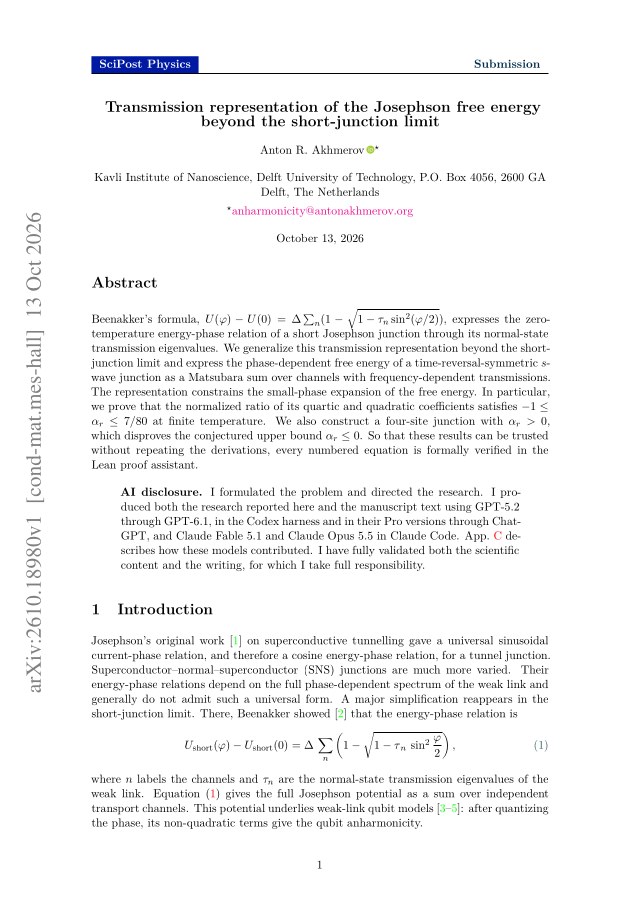
Beenakker's formula, $U(\varphi)-U(0)=Δ\sum_n\bigl(1-\sqrt{1-τ_n\sin^2(\varphi/2)}\bigr)$, expresses the zero-temperature energy-phase relation of a short Josephson junction through its normal-state transmission eigenvalues. We generalize this transmission representation beyond the short-junction limit and express the phase-dependent free energy of a time-reversal-symmetric $s$-wave junction as a Matsubara sum over channels with frequency-dependent transmissions. The representation constrains the small-phase expansion of the free energy. In particular, we prove that the normalized ratio of its quartic and quadratic coefficients satisfies $-1\leα_r\le7/80$ at finite temperature. We also construct a four-site junction with $α_r>0$, which disproves the conjectured upper bound $α_r\le0$. So that these results can be trusted without repeating the derivations, every numbered equation is formally verified in the Lean proof assistant.

Beenakker's formula gives the Josephson energy-phase relation of short junctions as a sum over normal-state transmission channels. No comparable channel representation exists beyond the short-junction limit. The allowed range of the normalized quartic coefficient α_r was also open, with a conjectured bound -1 ≤ α_r ≤ 0.

The phase-dependent free energy of a time-reversal-symmetric s-wave Bogoliubov–de Gennes junction is rewritten as a Matsubara sum. Each term is reduced to channel spaces using Takagi and skew-Takagi factorizations of the pairing blocks, which yields frequency-dependent transmissions. Bounds on the phase-expansion coefficients follow from termwise positivity and from analytic constraints on how fast transmissions decay with frequency. All numbered equations were formalized in Lean 4 with Mathlib by AI agents, and the manuscript is generated from the checked declarations.

The authors prove -1 ≤ α_r ≤ 7/80 at finite temperature and α_r ≤ (16-5π)/[4(4-π)] ≈ 0.085 at zero temperature. A four-site junction with α_r ≈ 0.0063 > 0 disproves the conjectured bound α_r ≤ 0. The Lean formalization and agent session logs are released on Zenodo.