
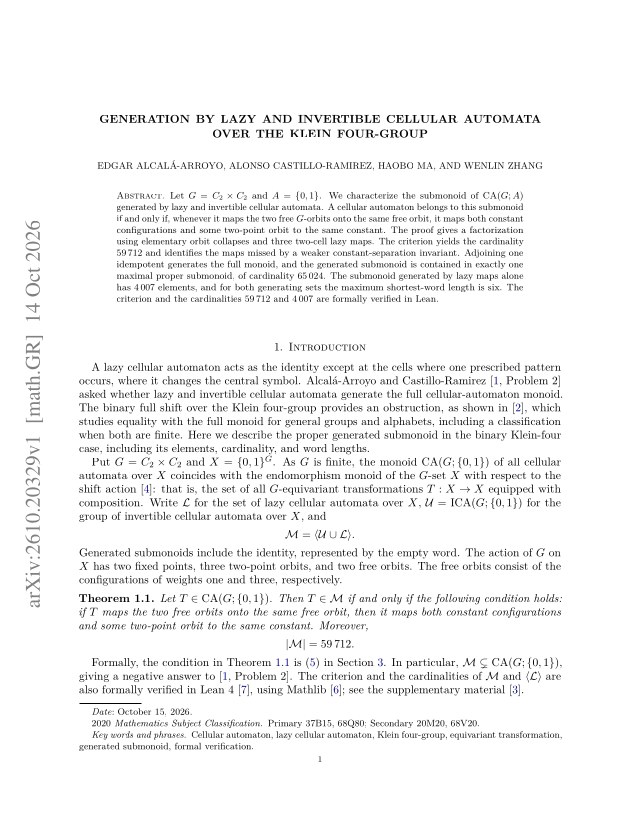
Generation by lazy and invertible cellular automata over the Klein four-group
Alcalá-Arroyo and Castillo-Ramirez asked whether lazy and invertible cellular automata generate the full cellular-automaton monoid. The binary full shift over the Klein four-group is known to be an obstruction. The open task is to describe the proper submonoid these maps generate in that case.
The monoid CA(G;{0,1}) is identified with the endomorphism monoid of the G-set {0,1}^G, which has seven orbits. Membership is characterized through a factorization into elementary orbit collapses and three two-cell lazy maps. Relative rank and maximal submonoids are analyzed using rank ideals. The criterion and the cardinalities are formalized in Lean 4 with Mathlib, using only the standard axioms.
A map lies in the generated submonoid exactly when, whenever it merges the two free orbits, it sends both constants and some two-point orbit to the same constant. The submonoid has 59,712 elements and adjoining one idempotent generates the full monoid. It lies in a unique maximal proper submonoid of size 65,024. The lazy-only submonoid has 4,007 elements, and the maximum shortest-word length is six for both generating sets.
| Set | Size |
|---|---|
| CA(G;A) | 65,536 |
| Invertible CA | 512 |
| Generated submonoid M | 59,712 |
| Unique maximal proper submonoid containing M | 65,024 |
| Lazy-only submonoid | 4,007 |