Chemotaxis models with signal-dependent sensitivity and a logistic-type source, III: Bifurcation and spike-like solutions
Le Chen, Ian Ruau, Wenxian Shen
math.AP
Oct 14, 2026 · v2
TL;DR
Selected results and conditional deductions on chemotaxis bifurcation are formalized in a Lean 4 companion artifact; the formalization covers only part of the paper.
Abstract
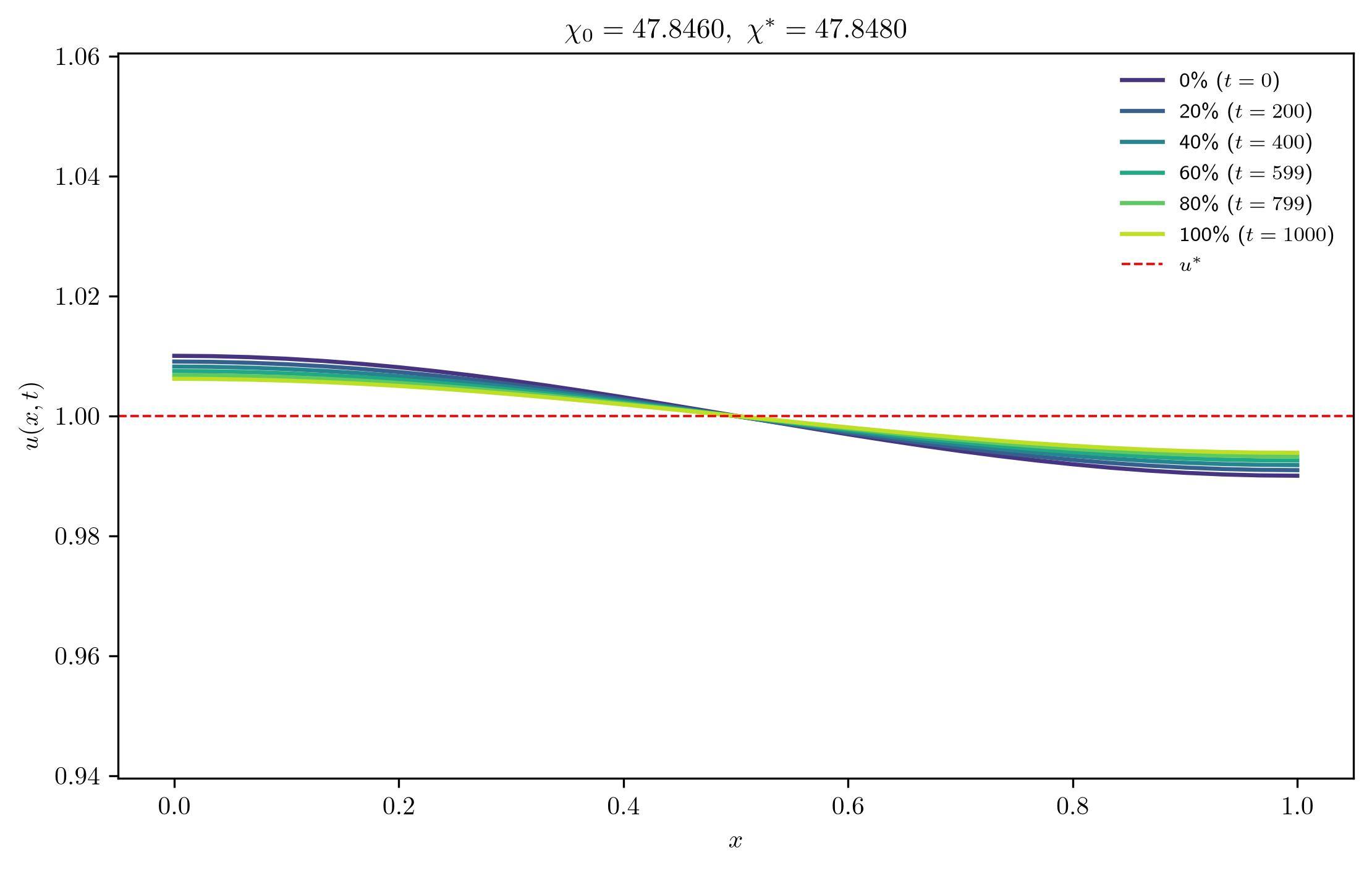
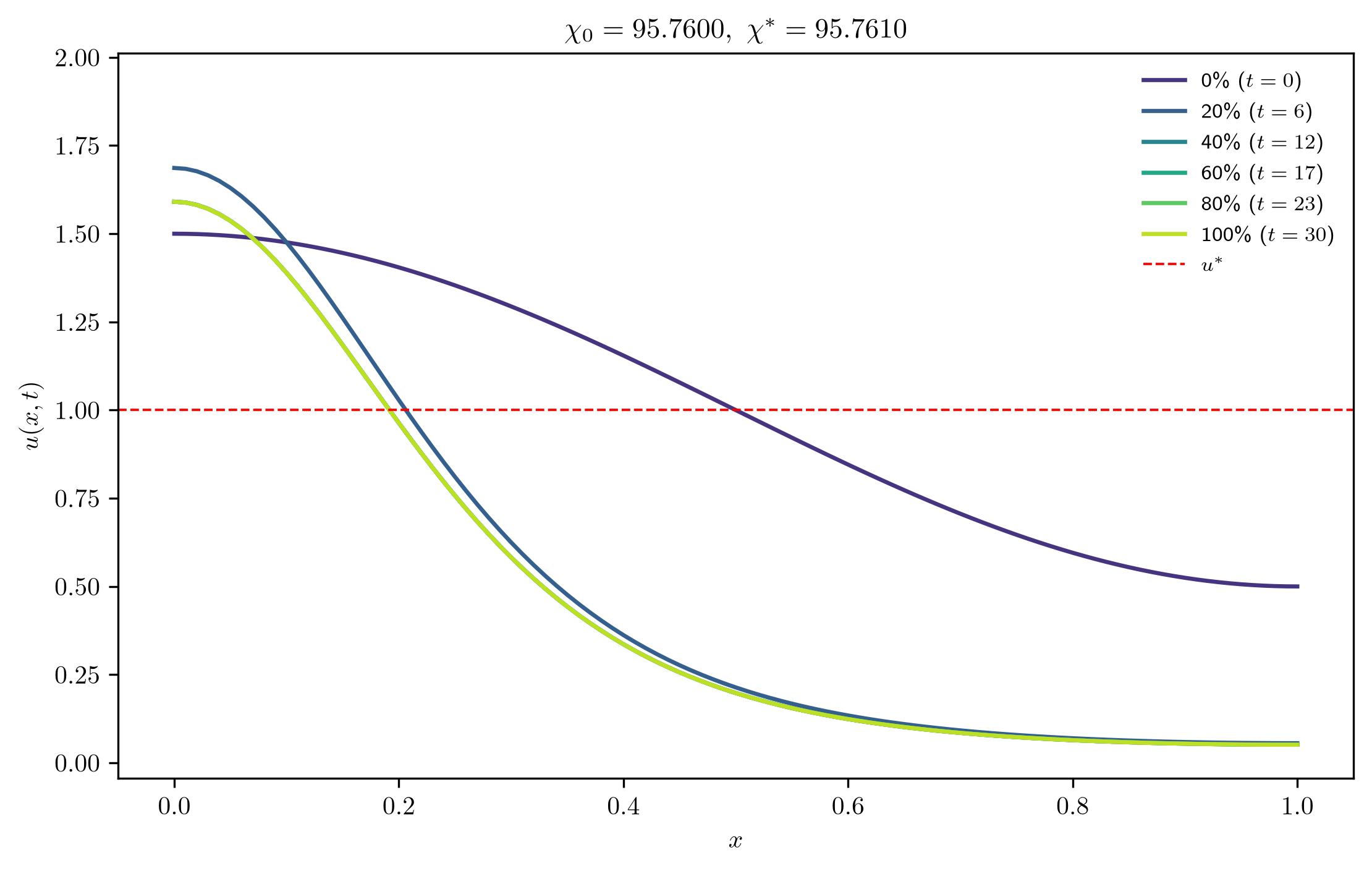
This third paper in a series on a parabolic-elliptic chemotaxis model studies bifurcation of positive constant equilibria in one space dimension. We consider $$ \left\{ \begin{array}{ll} u_t=Δu-χ_0\nabla\cdot\left(\frac{u^m}{(1+v)^β}\nabla v\right)+au-bu^{1+α}, & x\inΩ,\\ 0=Δv-μv+νu^γ, & x\inΩ,\\ \frac{\partial u}{\partial n}=\frac{\partial v}{\partial n}=0, & x\in\partialΩ, \end{array} \right. $$ where $Ω$ is a bounded interval, $α,γ,m,μ,ν>0$, $χ_0\in\mathbb R$, and $a,b,β\ge0$. Building on earlier results on global existence, boundedness, persistence, and stabilization, we take $χ_0$ as the bifurcation parameter and examine the effects of $β$ and the domain size on the bifurcation. Center manifold reduction yields a coefficient $β_{n_0}$ at a simple bifurcation mode $n_0$ of a positive constant equilibrium. The pitchfork bifurcation is supercritical if $β_{n_0}>0$ and subcritical if $β_{n_0}<0$. Stronger desensitization raises the sensitivity required for loss of linear stability. Bifurcation may be supercritical for small $β$ but is always subcritical for sufficiently large $β$. Thus, desensitization makes patterns harder to trigger and favors abrupt rather than continuous emergence. The bifurcation mode increases with domain size, allowing more complex spatial patterns. Under suitable conditions, we prove unbounded continuation of local bifurcation branches. We also show that large-sensitivity stationary sequences satisfying a peak-gap hypothesis develop spike-like profiles. Numerical continuation and time-evolution experiments illustrate the bifurcating branches and spike-like solutions and suggest unbounded continuation and increasingly sharp stationary profiles.
Problem
The paper studies bifurcation of positive constant equilibria in a one-dimensional parabolic-elliptic chemotaxis model with signal-dependent sensitivity and a logistic-type source. It asks how the desensitization exponent β and the domain size affect the direction and mode of the bifurcation.
Approach
Center manifold reduction at a simple bifurcation mode yields a coefficient β_{n0}, whose sign determines whether the pitchfork bifurcation is supercritical or subcritical. A priori estimates and global bifurcation arguments establish unbounded continuation of the local branches. A convergence argument at large sensitivity shows spike-like profiles under a peak-gap hypothesis. Finite-difference numerics illustrate the theory, and a Lean 4 companion formalizes selected results and conditional deductions.
Results
Stronger desensitization raises the instability threshold. The bifurcation can be supercritical for small β but is always subcritical for large β, and the bifurcation mode increases with domain size. Local branches continue unboundedly, and large-sensitivity stationary solutions develop spike-like profiles, as the numerical experiments also show.