
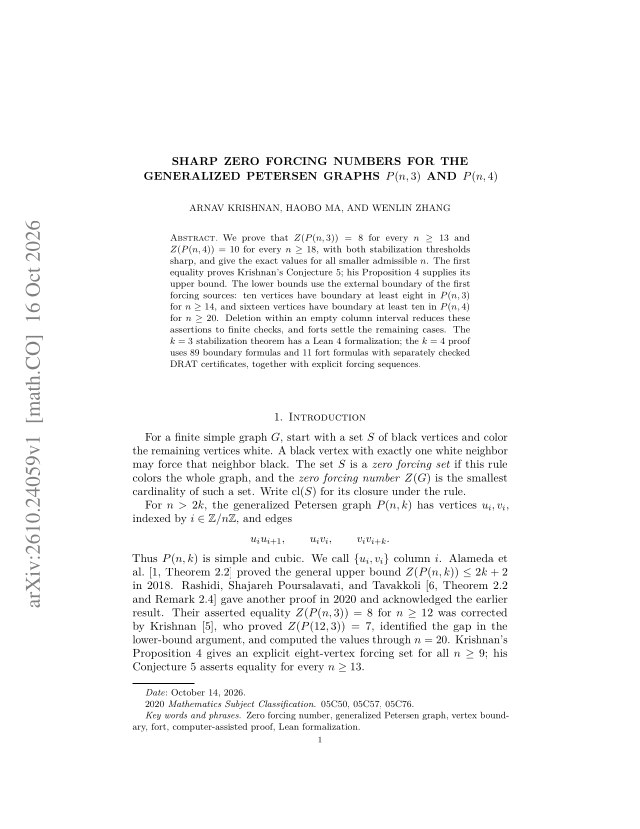
Sharp zero forcing numbers for the generalized Petersen graphs $P(n,3)$ and $P(n,4)$
The goal is to determine the zero forcing numbers of the generalized Petersen graphs P(n,3) and P(n,4) for all n. A central case is Krishnan's Conjecture 5, which states that Z(P(n,3))=8 for all n≥13.
A zero forcing set yields the sources of its first forces, and these form a vertex set with small external boundary. Deleting a column inside an empty interval of columns preserves the boundary, which reduces the problem to finite checks. For k=3 the finite checks run over gap words and layer assignments, using a C checker, and the stabilization theorem is formalized in Lean 4 with Mathlib. For k=4 the finite checks use 89 boundary SAT formulas and 11 fort formulas, each with a DRAT certificate, plus explicit forcing sequences.
Z(P(n,3))=8 for all n≥13 and Z(P(n,4))=10 for all n≥18, and both thresholds are sharp. Exact values are given for all smaller admissible n. Only the k=3 result is Lean-formalized; the k=4 formalization is left to future work.
| n | 7 | 8 | 9 | 10 | 11 | 12 |
|---|---|---|---|---|---|---|
| Z(P(n,3)) | 6 | 6 | 6 | 8 | 7 | 7 |