Builds an agentic LLM harness that develops Lean 4 proofs and verified code, coordinating parallel workers in a shared Lean workspace checked by the kernel.
Abstract
Lean is increasingly used to verify mathematical proofs and software produced by LLM agents, but writing formal proofs remains hard. Existing prover systems take a divide-and-conquer approach that recursively decomposes hard proof goals into easier lemmas and splits again any lemma that resists proof. However, a lemma can resist proof for different reasons, including insufficient guidance, a false statement, or a flaw in the decomposition that produced it. Existing systems cannot tell these apart as a failed attempt reports little beyond its failure, and responses are confined to the failing node without considering the rest of the proof or revising the plan above it. The system may thus keep decomposing obligations along a flawed proof direction until the budget runs out, causing the whole proof attempt to fail. We introduce Maestro, a Lean prover harness that handles failures through global coordination. Provers report why they failed, not just that they failed, and a coordinator that sees the whole proof chooses an appropriate response, such as guiding a stuck prover, correcting a false lemma, or retracting a flawed subtree and replanning it. The same harness extends to verified code synthesis, where a checked counterexample sends the code back for repair. We evaluate Maestro with four frontier LLMs on seven mathematics and three software verification benchmarks. It proves more targets than each model's native coding agent (Claude Code or Codex) on every benchmark the agent has not already saturated, with the largest gains on research-level mathematics. With Claude Opus 5, it discovers its own proofs of 34 of the 48 theorems in the June 2026 release of arXivLean, against 19 for the native agent. It also outperforms all published prover systems on every benchmark they share, solving 669/672 PutnamBench, 59/60 Lean-IMO-Bench, and 6/6 IMO 2026.
Problem
Recursive-decomposition Lean provers handle failure locally. They keep splitting a stuck lemma even when the real cause is a false statement or a flawed plan higher up, which wastes budget and causes whole proof attempts to fail.
Approach
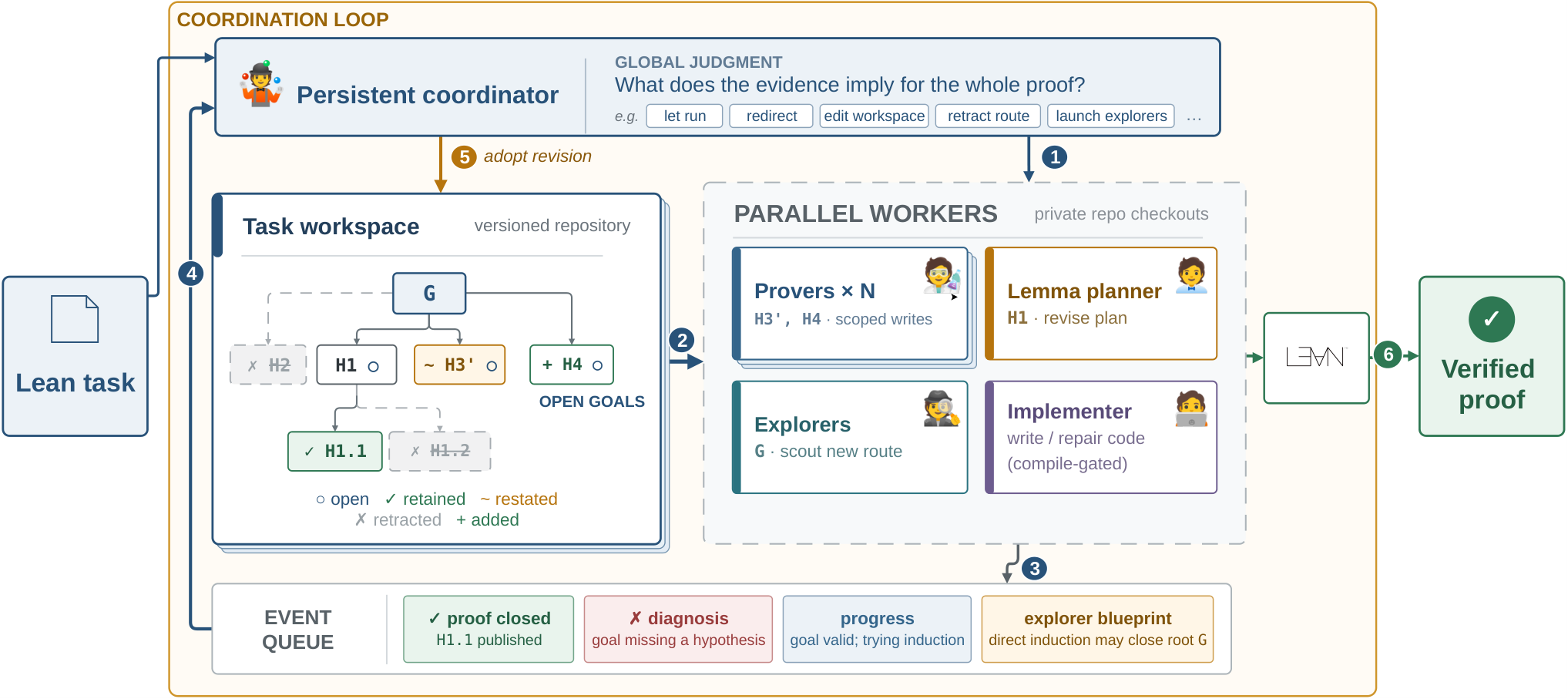
Maestro keeps a Lean 4 workspace as the record of proved and open obligations. Parallel workers (provers, local lemma planners, free-form explorers, and code workers) report diagnoses of why an attempt failed. A single coordinator that sees the whole proof chooses a response: guiding a prover, correcting a false lemma, retracting and replanning a subtree, or returning a machine-checked falsification. The same loop extends to verified code synthesis, where a checked counterexample sends the code back for repair.
Figure 1: Maestro ’s coordination loop. The persistent coordinator 1 dispatches or redirects workers, which 2 attack open obligations in parallel and 3 report proofs, diagnoses, progress, or blueprints to a shared queue. The coordinator 4 consumes these events as they arrive and 5 revises the shared Lean workspace, here retracting H2 and H1.2 , restating H3 as H3’ , adding H4 , and keeping the pro
Results
Across four frontier LLMs and ten benchmarks, Maestro beats each model's native coding agent on every benchmark the agent had not already saturated, with the largest gains on research-level mathematics. With Claude Opus 5 it proves 34/48 June 2026 arXivLean theorems versus 19 for the native agent. It solves 669/672 PutnamBench, 59/60 Lean-IMO-Bench and 6/6 IMO 2026, outperforming all published prover systems on every shared benchmark.
Method
IMO'26 (6)
Putnam (672)
LIB (60)
aXL-06 (48)
FATE-X (100)
Claude Code
4
667
56
19
73
Maestro
6
669+2
59+1
34+2
90+6
Opus 5: native coding agent vs Maestro (a+b = proved + falsified)