
← All papers
First page of The algebraic and geometric classification of $3$-Poisson algebras

The algebraic and geometric classification of $3$-Poisson algebras

Hani Abdelwahab, Kobiljon Abdurasulov, Ivan Kaygorodov

math.RA Oct 19, 2026 · v2
The multiplication tables of both classification theorems were checked formally in Lean 4, with the Aristotle AI system assisting the formal verification.
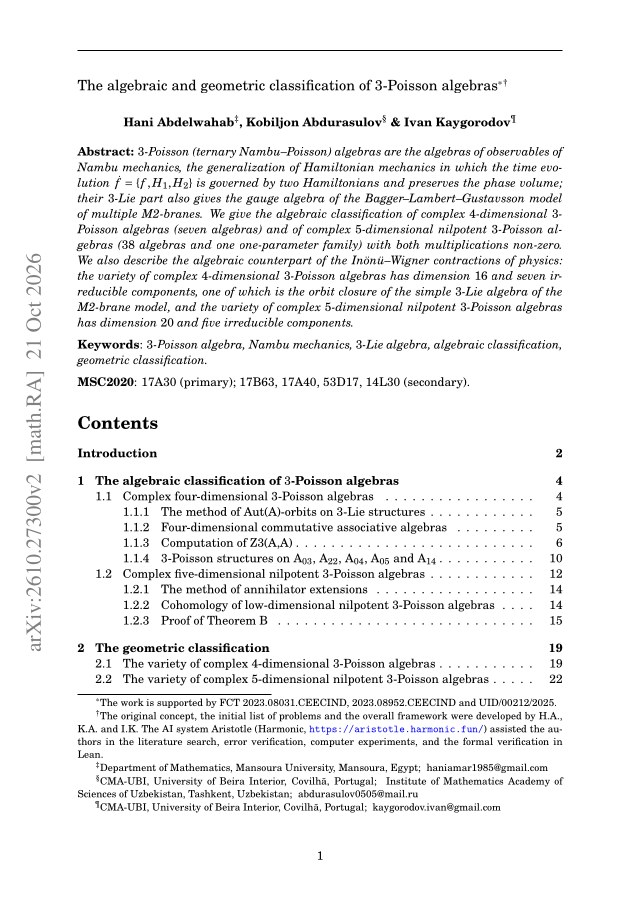
$3$-Poisson (ternary Nambu–Poisson) algebras are the algebras of observables of Nambu mechanics, the generalization of Hamiltonian mechanics in which the time evolution $\dot f=\{f,H_1,H_2\}$ is governed by two Hamiltonians and preserves the phase volume; their $3$-Lie part also gives the gauge algebra of the Bagger–Lambert–Gustavsson model of multiple M2-branes. We give the algebraic classification of complex $4$-dimensional $3$-Poisson algebras (seven algebras) and of complex $5$-dimensional nilpotent $3$-Poisson algebras ($38$ algebras and one one-parameter family) with both multiplications non-zero. We also describe the algebraic counterpart of the Inönü–Wigner contractions of physics: the variety of complex $4$-dimensional $3$-Poisson algebras has dimension $16$ and seven irreducible components, one of which is the orbit closure of the simple $3$-Lie algebra of the M2-brane model, and the variety of complex $5$-dimensional nilpotent $3$-Poisson algebras has dimension $20$ and five irreducible components.

The goal is to classify 3-Poisson (ternary Nambu–Poisson) algebras of small dimension, both up to isomorphism and geometrically through degenerations. These algebras are the algebras of observables of Nambu mechanics, and their 3-Lie part gives the gauge algebra of the Bagger–Lambert–Gustavsson model of multiple M2-branes.

Complex 4-dimensional 3-Poisson algebras, and complex 5-dimensional nilpotent ones, with both multiplications non-zero are classified algebraically. The method extends commutative associative algebras by 3-Lie cocycles satisfying the Leibniz rule, taken up to automorphism. The algebraic varieties of such structures are then studied under the GL action, using orbit dimensions, explicit degenerations and Borel-invariant non-degeneration arguments. The resulting multiplication tables were checked formally in Lean 4 with assistance from the Aristotle AI system.

There are seven 4-dimensional algebras, and 38 algebras plus one one-parameter family in the 5-dimensional nilpotent case. The 4-dimensional variety has dimension 16 and seven irreducible components, one of which is the orbit closure of the simple M2-brane 3-Lie algebra. The 5-dimensional nilpotent variety has dimension 20 and five irreducible components.