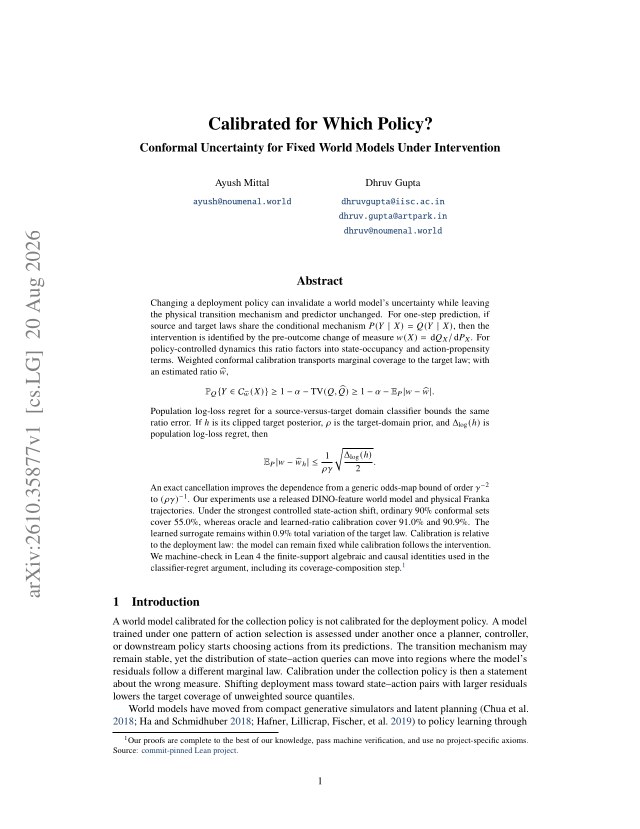
Calibrated for Which Policy? Conformal Uncertainty for Fixed World Models Under Intervention
Ayush Mittal, Dhruv Gupta
cs.LG
Aug 20, 2026 · v1
cs.RO stat.ML
TL;DR
Finite-support versions of the posterior-to-ratio identity, classifier-regret bound, policy-shift factorization, and coverage composition are formalized in Lean 4 with Mathlib.
Abstract
Changing a deployment policy can invalidate a world model's uncertainty while leaving the physical transition mechanism and predictor unchanged. For one-step prediction, if source and target laws share the conditional mechanism $P(Y|X)=Q(Y|X)$, then the intervention is identified by the pre-outcome change of measure $w(X)=dQ_X/dP_X$. For policy-controlled dynamics this ratio factors into state-occupancy and action-propensity terms. Weighted conformal calibration transports marginal coverage to the target law; with an estimated ratio $\hat w$, $P_Q\{Y \in C_{\hat w}(X)\} \ge 1-α-TV(Q,\hat Q) \ge 1-α-E_P|w-\hat w|$. Population log-loss regret for a source-versus-target domain classifier bounds the same ratio error. If $h$ is its clipped target posterior, $ρ$ is the target-domain prior, and $Δ(h)$ is population log-loss regret, then $E_P|w-\hat w_h| \le (1/(ργ))\sqrt{Δ(h)/2}$. An exact cancellation improves the dependence from a generic odds-map bound of order $γ^{-2}$ to $(ργ)^{-1}$. Our experiments use a released DINO-feature world model and physical Franka trajectories. Under the strongest controlled state-action shift, ordinary 90% conformal sets cover 55.0%, whereas oracle and learned-ratio calibration cover 91.0% and 90.9%. The learned surrogate remains within 0.9% total variation of the target law. Calibration is relative to the deployment law: the model can remain fixed while calibration follows the intervention. We machine-check in Lean 4 the finite-support algebraic and causal identities used in the classifier-regret argument, including its coverage-composition step.
Problem
A world model's conformal uncertainty is calibrated under the data-collection policy and can lose validity when the deployment policy changes, even though the transition mechanism and predictor stay the same. The question is how to transport coverage to the deployment law and bound the error introduced by an estimated density ratio.
Approach
When the conditional mechanism is shared, the intervention is identified by a pre-outcome change of measure, which for policy-controlled dynamics factors into state-occupancy and action-propensity terms. Weighted conformal calibration transports coverage, with a total-variation penalty for an estimated ratio. A source-versus-target domain classifier's log-loss regret bounds the ratio error at order (ργ)^{-1}, using an exact cancellation. The finite-support algebraic and causal identities and the coverage-composition step are machine-checked in Lean 4 with Mathlib, in a commit-pinned repository.
Results
With a frozen DINO-WM on physical Franka transitions, under the strongest shift ordinary 90% conformal sets cover 55.0%, while oracle and learned-ratio calibration cover 91.0% and 90.9%. The learned surrogate stays within 0.9% total variation of the target law.
| λ | TV | Unweighted | Oracle | Estimated |
|---|
| 0 | 0.0% | 90.2% | 90.2% | 90.3% |
| 0.5 | 24.6% | 81.6% | 90.5% | 90.6% |
| 1 | 46.4% | 69.0% | 91.8% | 91.8% |
| 1.5 | 63.7% | 55.0% | 91.0% | 90.9% |
Coverage at nominal 90% under controlled shift λ