
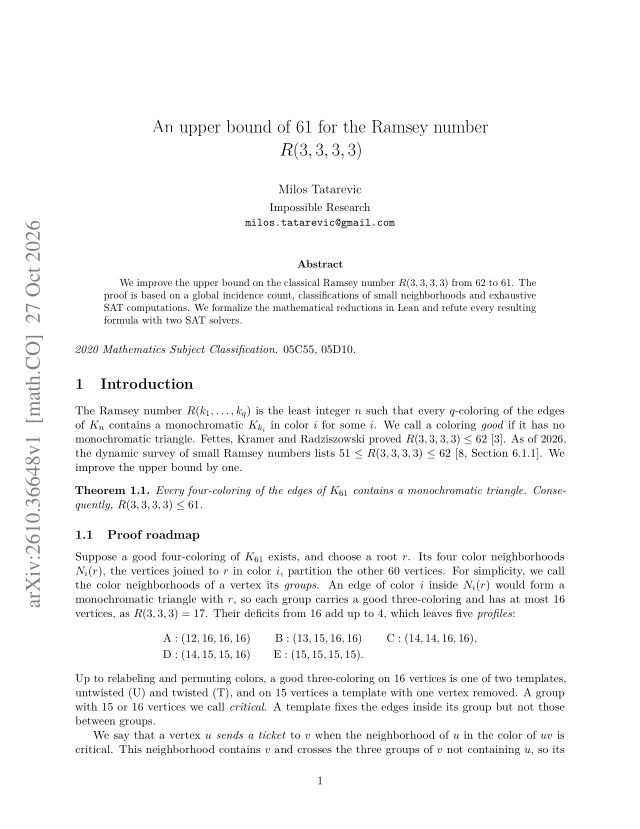
An upper bound of 61 for the Ramsey number $R(3,3,3,3)$
The best known upper bound for the classical Ramsey number R(3,3,3,3) was 62. The goal is to show that every four-coloring of the edges of K_61 has a monochromatic triangle, which lowers the bound to 61.
Assume a good four-coloring of K_61 exists. Each vertex has one of five degree profiles, and a global double count of 'tickets' (sent along critical neighborhoods) narrows the remaining cases. The proof also uses the known classification of good three-colorings of K_15 and K_16 into the U and T templates. The remaining cases (marked-neighborhood placements, C entrances, perfect balance) reduce to 56,723 CNF formulas. A Lean 4 formalization proves the reductions, checks 55 CNF/LRAT classification certificates, and emits the formulas; Kissat and CaDiCaL refute each formula.
Every formula was found UNSAT by both solvers, using about 677 CPU hours, which gives R(3,3,3,3) ≤ 61. The final Lean theorem, UniformK61.WholeProof.ramsey61, has the unsatisfiability of the 56,723 formulas as its only premise and otherwise uses only the standard axioms.
| Case family | Formulas | Kissat | CaDiCaL |
|---|---|---|---|
| A | 360 | 0.31 | 1.71 |
| B | 5,096 | 7.45 | 41.21 |
| C entrance | 346 | 0.26 | 1.42 |
| Perfect balance | 3 | 0.02 | 0.03 |
| Total | 56,723 | 184.06 | 492.71 |