
A power-saving asymptotic for a Möbius-weighted GCD quadratic form
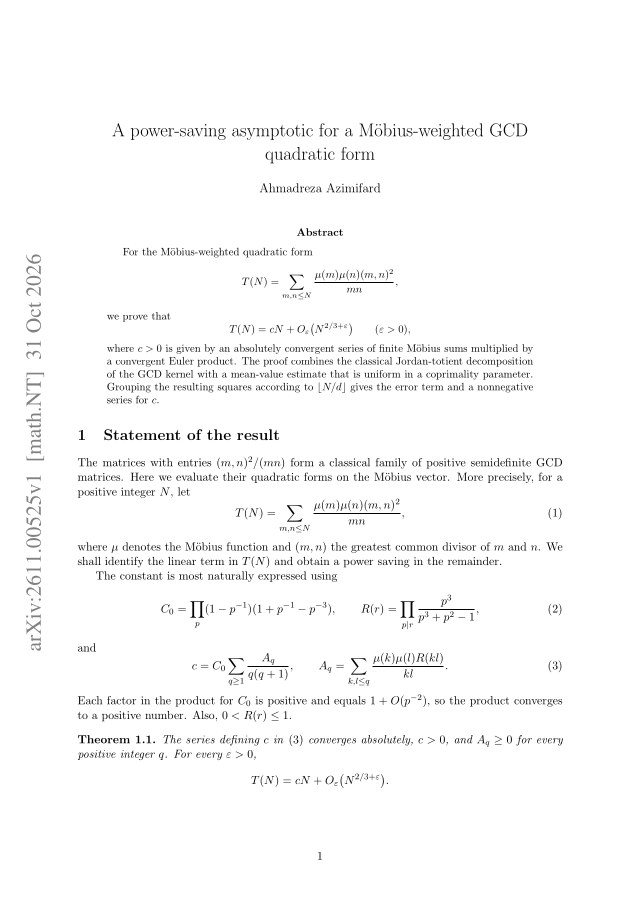
The goal is to determine the asymptotic behaviour of the Möbius-weighted GCD quadratic form T(N)=Σ_{m,n≤N} μ(m)μ(n)(m,n)^2/(mn), including its linear term and a power-saving remainder.
The GCD kernel is decomposed via the Jordan totient J_2, which writes T(N) as a sum of nonnegative squares. A mean-value estimate for a multiplicative function, uniform in a coprimality parameter, is applied on hyperbola blocks where ⌊N/d⌋ is constant. Balancing the block errors against a direct bound for the remaining squares gives the exponent. The full result is formalized in Lean 4.28.0 with Mathlib.
T(N)=cN+O_ε(N^{2/3+ε}), where c≥C_0/2>0 is given by a nonnegative absolutely convergent series. The Lean theorem depends only on the standard axioms, with no admitted propositions. Numerically, T(10^6)/10^6≈0.33112, consistent with the computed value of c.