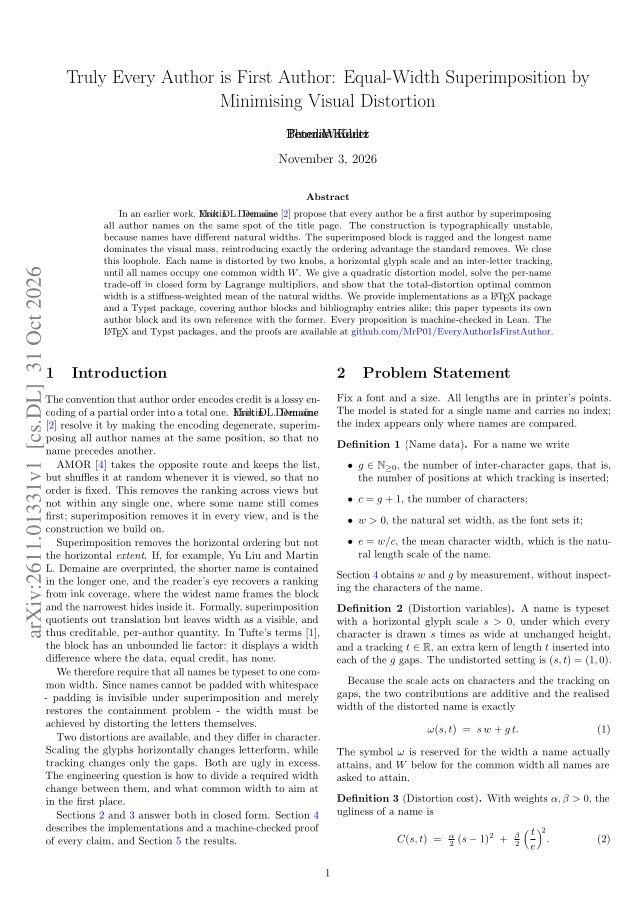
Truly Every Author is First Author: Equal-Width Superimposition by Minimising Visual Distortion
Peter Waldert, Benedikt Kantz, Thomas Köhler
cs.DL
Oct 31, 2026 · v1
TL;DR
Every proposition of the distortion model, including the per-name optimal split and the optimal common width, is machine-checked in Lean, with proofs released on GitHub.
Abstract
In an earlier work, Demaine and Demaine propose that every author be a first author by superimposing all author names on the same spot of the title page. The construction is typographically unstable, because names have different natural widths. The superimposed block is ragged and the longest name dominates the visual mass, reintroducing exactly the ordering advantage the standard removes. We close this loophole. Each name is distorted by two knobs, a horizontal glyph scale and an inter-letter tracking, until all names occupy one common width $W$. We give a quadratic distortion model, solve the per-name trade-off in closed form by Lagrange multipliers, and show that the total-distortion optimal common width is a stiffness-weighted mean of the natural widths. We provide implementations as a $\LaTeX$ package and a Typst package, covering author blocks and bibliography entries alike; this paper typesets its own author block and its own reference with the former. Every proposition is machine-checked in Lean. The $\LaTeX$ and Typst packages, as well as the proofs, are available at
https://github.com/MrP01/EveryAuthorIsFirstAuthor.
Problem
When author names are superimposed so that every author is first author, names of different natural widths produce a ragged block in which the longest name dominates visually. That reintroduces an ordering advantage.
Approach
Each name is distorted by a horizontal glyph scale and an inter-letter tracking until all names reach one common width W. A quadratic distortion cost is defined, and the per-name trade-off is solved in closed form with Lagrange multipliers. The total-distortion-optimal W is derived. Implementations are provided as LaTeX and Typst packages, and all propositions are machine-checked in Lean.
Results
For a fixed width, the minimiser splits the correction between tracking and scaling in roughly the ratio α:β, with optimal cost (W−w)²/(2K). The optimal common width is a stiffness-weighted mean of the natural widths. The packages typeset the paper's own author block, and the Lean proofs are released publicly.