
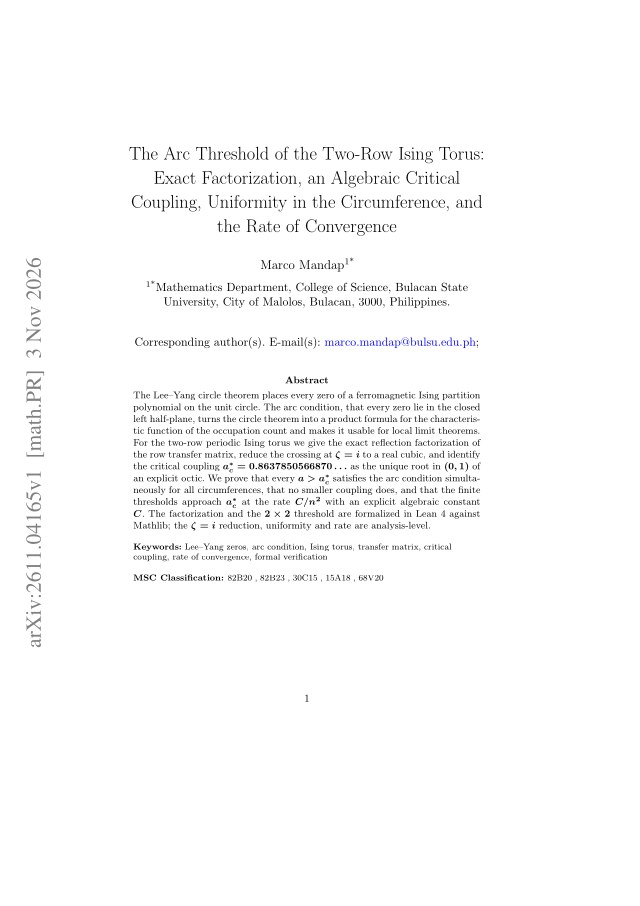
The Arc Threshold of the Two-Row Ising Torus: Exact Factorization, an Algebraic Critical Coupling, Uniformity in the Circumference, and the Rate of Convergence
The arc condition requires every Lee–Yang zero of a ferromagnetic Ising partition polynomial to lie in the closed left half-plane, which makes local limit theorems usable. The question is which couplings satisfy it for the two-row periodic Ising torus, uniformly in the circumference.
A reflection decomposition splits the 4×4 row transfer matrix into a symmetric 3×3 block plus a scalar, giving a trace formula for the partition polynomial. The crossing at ζ = i reduces to a real cubic whose discriminant factors through an explicit octic. The factorization, characteristic polynomial, Cayley–Hamilton recurrence, and 2×2 threshold are kernel-checked in Lean 4 against Mathlib, with no sorry and only standard axioms. The ζ = i reduction, uniformity, and rate are proved on paper, not in Lean.
The critical coupling a_c* ≈ 0.86378505668702 is the unique root in (0,1) of the octic. Every a > a_c* satisfies the arc condition for all circumferences and no smaller coupling does. The finite thresholds converge to a_c* as C/n^2 with C ≈ 0.1914850, and the 2×2 threshold (√2−1)^{1/4} is formally verified.
| n | a_c(n) | # roots in (0,1) | n^2(a_c* − a_c(n)) |
|---|---|---|---|
| 1 | 0.802243262923 | 1 | 0.06154 |
| 2 | 0.840357849665 | 1 | 0.09371 |
| 10 | 0.862193565717 | 5 | 0.15915 |
| 30 | 0.863585658848 | 15 | 0.17946 |