The smallest-parts function and elliptic curves
Ajit Singh
math.NT
Nov 3, 2026 · v1
TL;DR
The paper's proofs of the spt congruences and trace identities were formalized and verified in Lean entirely by the AxiomProver system.
Abstract
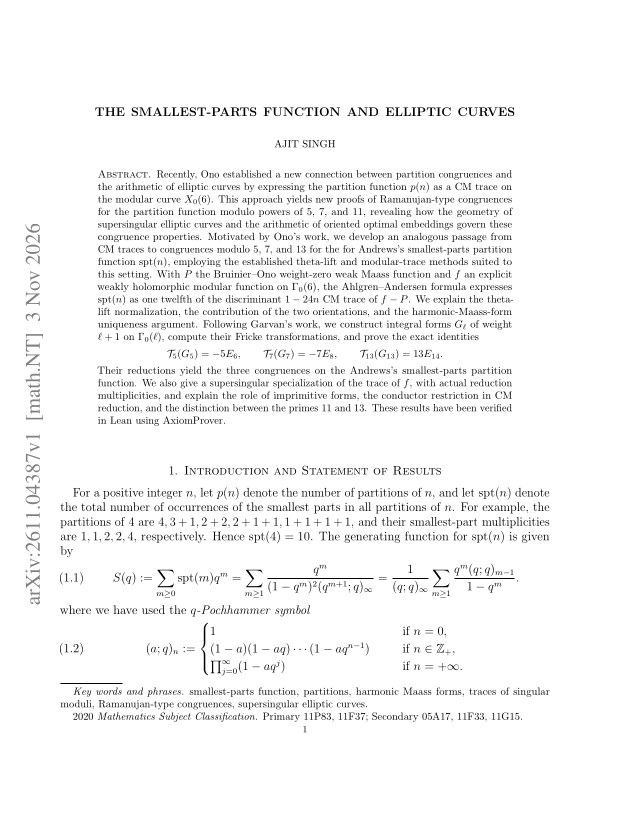
Recently, Ono established a new connection between partition congruences and the arithmetic of elliptic curves by expressing the partition function $p(n)$ as a CM trace on the modular curve $X_0(6)$. This approach yields new proofs of Ramanujan-type congruences for the partition function modulo powers of $5$, $7$, and $11$, revealing how the geometry of supersingular elliptic curves and the arithmetic of oriented optimal embeddings govern these congruence properties. Motivated by Ono's work, we develop an analogous passage from CM traces to congruences modulo $5$, $7$, and $13$ for the for Andrews's smallest-parts partition function $spt(n)$, employing the established theta-lift and modular-trace methods suited to this setting. With $P$ the Bruinier–Ono weight-zero weak Maass function and $f$ an explicit weakly holomorphic modular function on $Γ_0(6)$, the Ahlgren–Andersen formula expresses $spt(n)$ as one twelfth of the discriminant $1-24n$ CM trace of $f-P$. We explain the theta-lift normalization, the contribution of the two orientations, and the harmonic-Maass-form uniqueness argument. Following Garvan's work, we construct integral forms $G_\ell$ of weight $\ell+1$ on $Γ_0(\ell)$, compute their Fricke transformations, and prove the exact identities $$ \mathcal T_5(G_5)=-5E_6,\qquad \mathcal T_7(G_7)=-7E_8,\qquad \mathcal T_{13}(G_{13})=13E_{14}. $$ Their reductions yield the three congruences on the Andrews's smallest-parts partition function. We also give a supersingular specialization of the trace of $f$, with actual reduction multiplicities, and explain the role of imprimitive forms, the conductor restriction in CM reduction, and the distinction between the primes $11$ and $13$. These results have been verified in Lean using AxiomProver.
Problem
Following Ono's expression of p(n) as a CM trace on X_0(6), the goal is an analogous passage from CM traces to the Andrews congruences modulo 5, 7, and 13 for the smallest-parts function spt(n).
Approach
The Ahlgren–Andersen formula expresses spt(n) as one twelfth of a discriminant 1-24n CM trace of f-P, where P is the Bruinier–Ono weak Maass function and f is a weakly holomorphic function on Γ_0(6). The theta-lift normalization, the contribution of the two orientations, and the harmonic-Maass-form uniqueness argument are explained. Following Garvan, integral forms G_ℓ of weight ℓ+1 on Γ_0(ℓ) are constructed, and their Fricke transformations and group traces to SL_2(Z) are computed. The proofs were then formally verified in Lean by AxiomProver.
Results
The exact identities T_5(G_5)=-5E_6, T_7(G_7)=-7E_8, and T_13(G_13)=13E_14 are proved, and their reductions give the three spt congruences. A supersingular specialization of the trace of f is also given, and the distinction between the primes 11 and 13 is explained.