Kaplansky's conjectures fail for torsion-free hyperbolic groups in positive characteristic
Nidhal Mghirbi, Seth Douglas
math.GR
Nov 3, 2026 · v1
math.RA
TL;DR
The main theorem, existence of the counterexample groups and the failure of all four Kaplansky conjectures for every prime p, is formalized in Lean 4. The formalization builds on OpenAI's Lean development, including its random-graph estimates.
Abstract
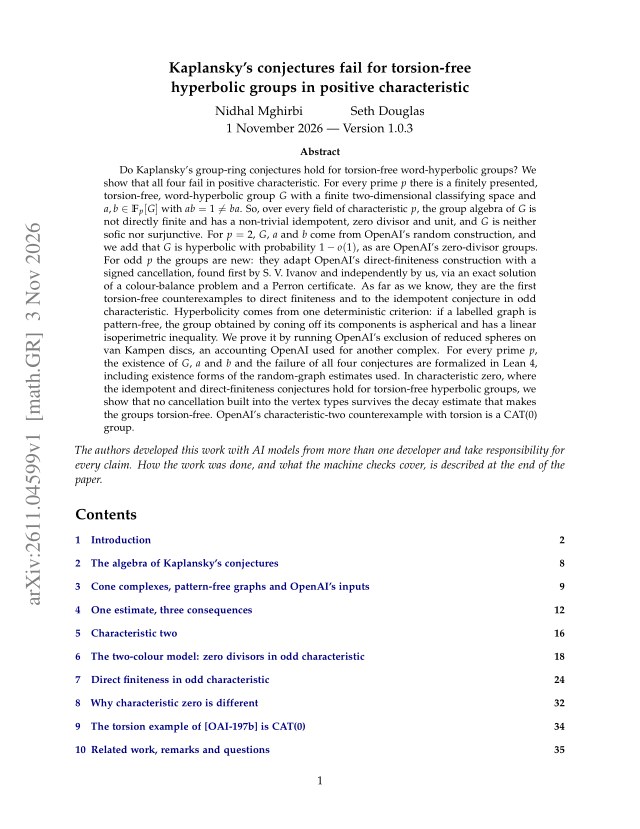
Do Kaplansky's group-ring conjectures hold for torsion-free word-hyperbolic groups? We show that all four fail in positive characteristic. For every prime $p$ there is a finitely presented, torsion-free, word-hyperbolic group $G$ with a finite two-dimensional classifying space and $a,b\in\mathbb{F}_p[G]$ with $ab=1\neq ba$. So, over every field of characteristic $p$, the group algebra of $G$ is not directly finite and has a non-trivial idempotent, zero divisor and unit, and $G$ is neither sofic nor surjunctive. For $p=2$, $G$, $a$ and $b$ come from OpenAI's random construction, and we add that $G$ is hyperbolic with probability $1-o(1)$, as are OpenAI's zero-divisor groups. For odd $p$ the groups are new: they adapt OpenAI's direct-finiteness construction with a signed cancellation, found first by S. V. Ivanov and independently by us, via an exact solution of a colour-balance problem and a Perron certificate. As far as we know, they are the first torsion-free counterexamples to direct finiteness and to the idempotent conjecture in odd characteristic. Hyperbolicity comes from one deterministic criterion: if a labelled graph is pattern-free, the group obtained by coning off its components is aspherical and has a linear isoperimetric inequality. We prove it by running OpenAI's exclusion of reduced spheres on van Kampen discs, an accounting OpenAI used for another complex. For every prime $p$, the existence of $G$, $a$ and $b$ and the failure of all four conjectures are formalized in Lean 4, including existence forms of the random-graph estimates used. In characteristic zero, where the idempotent and direct-finiteness conjectures hold for torsion-free hyperbolic groups, we show that no cancellation built into the vertex types survives the decay estimate that makes the groups torsion-free. OpenAI's characteristic-two counterexample with torsion is a CAT(0) group.
Problem
Do Kaplansky's group-ring conjectures (units, zero divisors, idempotents, direct finiteness) hold for torsion-free word-hyperbolic groups? No torsion-free hyperbolic counterexample to any of the four was previously known.
Approach
Groups are built as cone complexes over pattern-free labelled graphs. A single deterministic criterion makes such groups aspherical with a linear isoperimetric inequality, hence hyperbolic. For p=2 the construction reuses OpenAI's random construction. For odd p it adapts OpenAI's direct-finiteness construction using a signed cancellation, with vertex types taken from projective planes over finite fields. The main theorem and its consequences over every field of characteristic p are formalized in Lean 4, building on OpenAI's Lean development.
Results
For every prime p there is a finitely presented, torsion-free hyperbolic group G with a finite 2-dimensional classifying space and a,b in F_p[G] with ab=1≠ba. All four conjectures therefore fail, and G is neither sofic nor surjunctive. In characteristic zero, no cancellation built into the vertex types is compatible with the decay estimate that makes the groups torsion-free.
| Conjecture | char 0 | char 2 | odd char p |
|---|
| units (U) | open | fails | fails |
| zero divisors (Z) | open | fails | fails |
| idempotents (I) | holds | fails | fails |
| direct finiteness (D) | holds | fails | fails |
Status of Kaplansky's conjectures for torsion-free hyperbolic groups