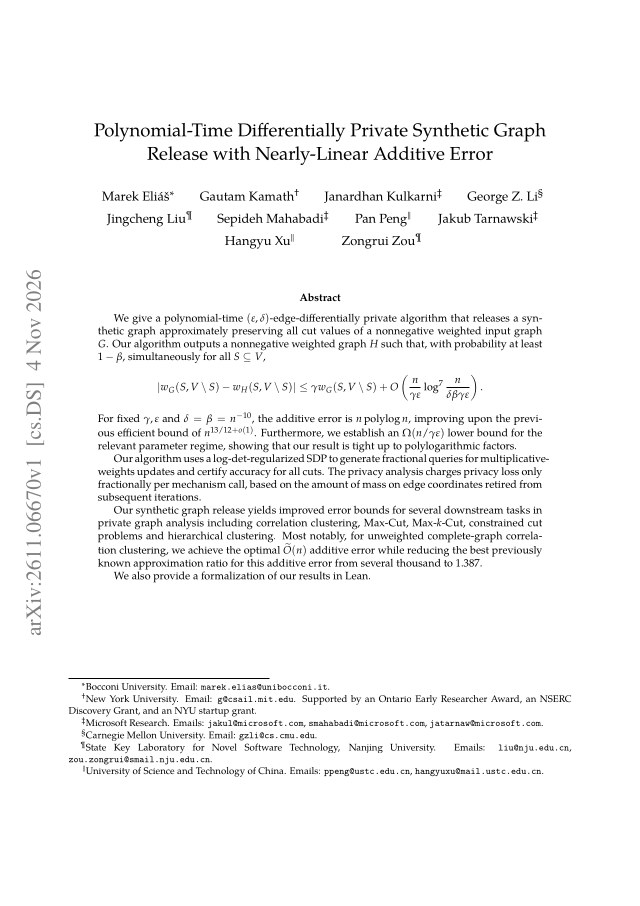
Polynomial-Time Differentially Private Synthetic Graph Release with Nearly-Linear Additive Error
Marek Eliáš, Gautam Kamath, Janardhan Kulkarni, George Z. Li, Jingcheng Liu, Sepideh Mahabadi, Pan Peng, Jakub Tarnawski, Hangyu Xu, Zongrui Zou
cs.DS
Nov 4, 2026 · v1
math.ST
TL;DR
The main differential-privacy synthetic graph theorem, including its polynomial running time, and a second theorem are formalized in Lean without unproven assumptions, with AI-assisted generation.
Abstract
We give a polynomial-time $(\varepsilon, δ)$-edge-differentially private algorithm that releases a synthetic graph approximately preserving all cut values of a nonnegative weighted input graph $G$. Our algorithm outputs a nonnegative weighted graph $H$ such that, with probability at least $1-β$, simultaneously for all $S\subseteq V$, \[ \left|w_G(S,V\setminus S)-w_H(S,V\setminus S)\right| \leq γw_G(S,V\setminus S) + O\left(\frac{n}{γ\varepsilon} \log^7 \frac{n}{δβγ\varepsilon}\right). \] For fixed $γ, \varepsilon$ and $δ= β= n^{-10}$, the additive error is $n \operatorname{polylog} n$, improving upon the previous efficient bound of $n^{13/12 + o(1)}$. Furthermore, we establish an $Ω(n/γ\varepsilon)$ lower bound for the relevant parameter regime, showing that our result is tight up to polylogarithmic factors. Our algorithm uses a log-det-regularized SDP to generate fractional queries for multiplicative-weights updates and certify accuracy for all cuts. The privacy analysis charges privacy loss only fractionally per mechanism call, based on the amount of mass on edge coordinates retired from subsequent iterations. Our synthetic graph release yields improved error bounds for several downstream tasks in private graph analysis including correlation clustering, Max-Cut, Max-$k$-Cut, constrained cut problems and hierarchical clustering. Most notably, for unweighted complete-graph correlation clustering, we achieve the optimal $\widetilde O(n)$ additive error while reducing the best previously known approximation ratio for this additive error from several thousand to $1.387$. We also provide a formalization of our results in Lean.
Problem
Release a synthetic weighted graph under edge differential privacy that approximately preserves all cut values. The goal is a polynomial-time algorithm with nearly linear additive error, improving the previous efficient bound of n^{13/12+o(1)}.
Approach
A log-det-regularized SDP produces fractional cut witnesses. These are aggregated to drive multiplicative-weights updates inside a PREM-style framework that proceeds over progressively smaller scales. The privacy analysis uses success-charged composition, charging privacy loss fractionally according to the mass retired on edge coordinates. Theorem 1, including its running time, and Theorem 38 are formalized in Lean, with the formalization generated with the help of AI systems.
Results
The additive error is O(n/(γε) log^7(n/(δβγε))), which is n polylog n. A matching Ω(n/(γε)) lower bound shows this is tight up to polylogarithmic factors. Downstream bounds improve for correlation clustering (1.387 ratio with Õ(n) additive error), Max-Cut, Max-k-Cut, and hierarchical clustering.
| Result | Privacy | Running time | Guarantee |
|---|
| [27] | approximate | polynomial | w_G(S) ± Õ(√(‖w‖₁ n)) |
| [1] | approximate | polynomial | (1±γ)w_G(S) ± n^{5/4+o(1)} |
| [28] | approximate | polynomial | (1±γ)w_G(S) ± n^{13/12+o(1)} |
| This work | approximate | polynomial | (1±γ)w_G(S) ± n polylog n |
Comparison of efficient private cut-approximating synthetic graph releases