Resolvent-Diagonal Energy of Isospectral Jacobi Matrices
Dmitry Pasechnyuk-Vilensky, Martin Takáč
math.OC
Nov 6, 2026 · v1
math.SP
TL;DR
The paper's mathematical results on resolvent-diagonal energy of isospectral Jacobi matrices are accompanied by formal proofs in Lean.
Abstract
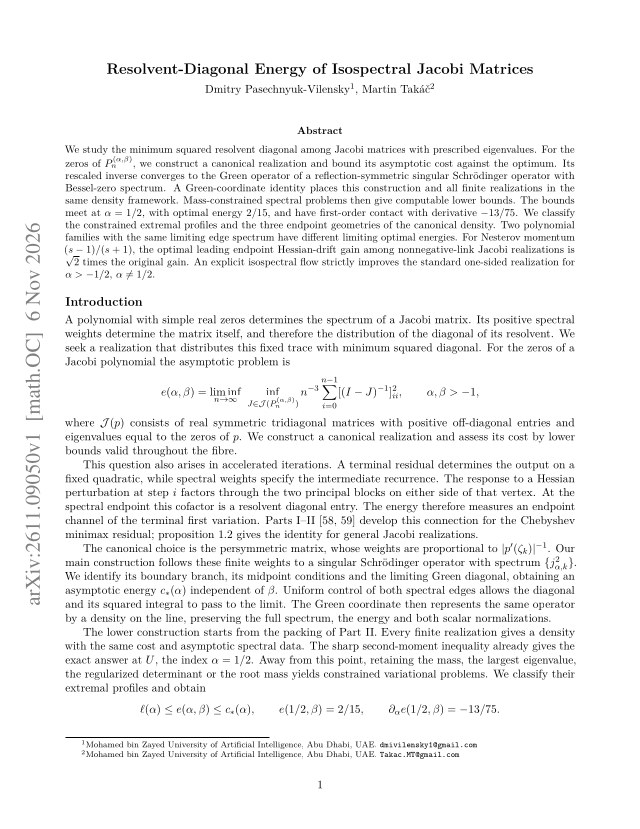
We study the minimum squared resolvent diagonal among Jacobi matrices with prescribed eigenvalues. For the zeros of $P_n^{(α,β)}$, we construct a canonical realization and bound its asymptotic cost against the optimum. Its rescaled inverse converges to the Green operator of a reflection-symmetric singular Schrödinger operator with Bessel-zero spectrum. A Green-coordinate identity places this construction and all finite realizations in the same density framework. Mass-constrained spectral problems then give computable lower bounds. The bounds meet at $α=1/2$, with optimal energy $2/15$, and have first-order contact with derivative $-13/75$. We classify the constrained extremal profiles and the three endpoint geometries of the canonical density. Two polynomial families with the same limiting edge spectrum have different limiting optimal energies. For Nesterov momentum $(s-1)/(s+1)$, the optimal leading endpoint Hessian-drift gain among nonnegative-link Jacobi realizations is $\sqrt{2}$ times the original gain. An explicit isospectral flow strictly improves the standard one-sided realization for $α>-1/2$, $α\ne1/2$.
Problem
The paper studies the minimum squared resolvent diagonal among Jacobi matrices with prescribed eigenvalues, focusing on eigenvalues given by the zeros of Jacobi polynomials P_n^(α,β).
Approach
A canonical Jacobi realization is constructed and its asymptotic cost is bounded against the optimum. Its rescaled inverse is shown to converge to the Green operator of a reflection-symmetric singular Schrödinger operator with Bessel-zero spectrum. A Green-coordinate identity places all finite realizations in a common density framework, and mass-constrained spectral problems give computable lower bounds. The results are accompanied by formal proofs in Lean.
Results
The upper and lower bounds meet at α=1/2 with optimal energy 2/15 and have first-order contact with derivative -13/75. For Nesterov momentum (s-1)/(s+1), the optimal leading endpoint Hessian-drift gain among nonnegative-link realizations is √2 times the original gain, and an explicit isospectral flow strictly improves the standard one-sided realization for α>-1/2, α≠1/2.