
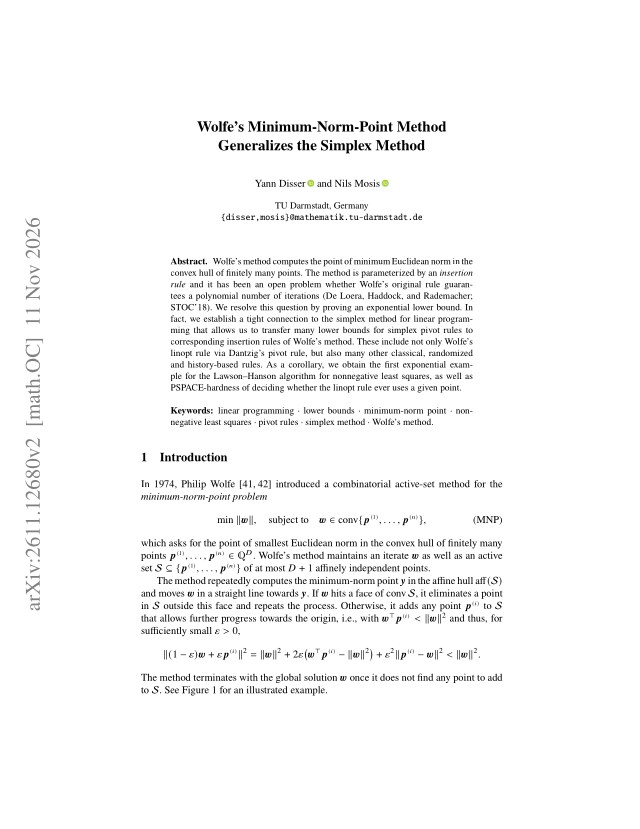
Wolfe's Minimum-Norm-Point Method Generalizes the Simplex Method
It was open whether Wolfe's minimum-norm-point method with Wolfe's original linopt insertion rule runs in a polynomial number of iterations. The question was posed by De Loera, Haddock, and Rademacher at STOC'18.
A linear program satisfying integrality, boundedness and nondegeneracy is transformed into a minimum-norm-point instance. Simplex executions on the LP then correspond one-to-one with executions of Wolfe's method on the new instance. This correspondence carries lower bounds for simplex pivot rules over to the matching insertion rules of Wolfe's method. The main theorem, corollaries and supporting statements were formally verified in Lean 4.
Wolfe's linopt rule takes exponentially many iterations, through Dantzig's pivot rule. Exponential or subexponential lower bounds also follow for least-index, least-inserted, round-robin and random insertion rules. Corollaries give the first exponential example for the Lawson-Hanson nonnegative least squares algorithm, and PSPACE-hardness of deciding whether linopt ever uses a given point.
| Insertion rule | Pivot rule | Lower bound |
|---|---|---|
| linopt | Dantzig | Ω(2^{n/2}) |
| least-index | Bland | Ω(2^{n/2}) |
| least inserted | Zadeh | 2^{Ω(n)} |
| round-robin | Cunningham | 2^{Ω(n)} |
| random | Random-Edge | 2^{Ω̃(n^{1/4})} |