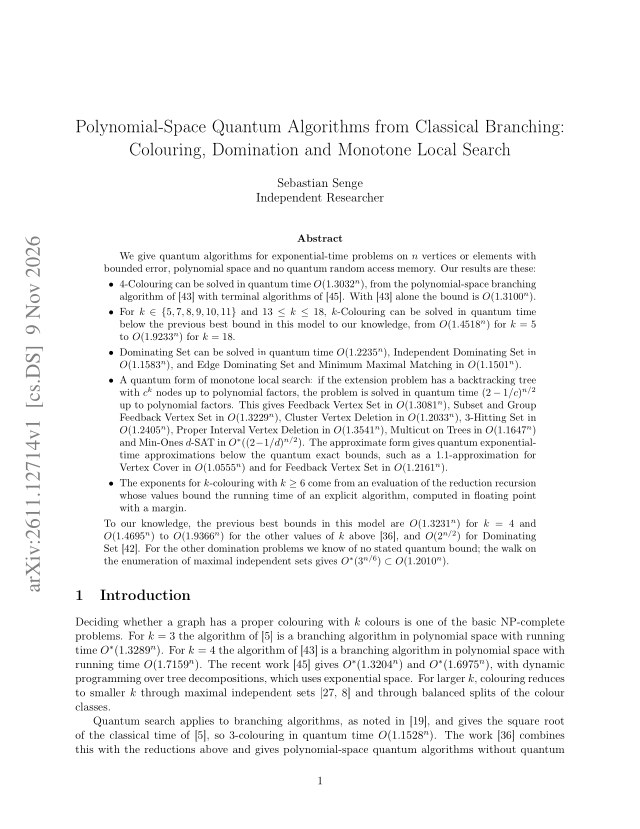
Polynomial-Space Quantum Algorithms from Classical Branching: Colouring, Domination and Monotone Local Search
Sebastian Senge
cs.DS
Nov 9, 2026 · v1
cs.CC quant-ph
TL;DR
A Lean library built on Mathlib machine-checks the numerical inequalities, closed-form exponent arithmetic and trigonometric amplitude-amplification identities behind the bounds; the algorithms themselves are not formalized.
Abstract
We give quantum algorithms for exponential-time problems on $n$ vertices or elements, with bounded error, polynomial space and no quantum random access memory. Our results are these. (1) 4-Colouring in quantum time $O(1.3032^n)$, from a polynomial-space branching algorithm with polynomial-space terminal algorithms; with the branching algorithm alone, $O(1.3100^n)$. The previous best bound in this model, to our knowledge, is $O(1.3231^n)$. (2) $k$-Colouring below the previous best bound for $k \in \{5, 7, 8, 9, 10, 11\}$ and $13 \le k \le 18$, from $O(1.4518^n)$ for $k = 5$ to $O(1.9233^n)$ for $k = 18$. (3) Dominating Set in $O(1.2235^n)$, against the previous $O(2^{n/2})$, Independent Dominating Set in $O(1.1583^n)$, and Edge Dominating Set and Minimum Maximal Matching in $O(1.1501^n)$. (4) A quantum form of monotone local search: if the extension problem has a backtracking tree with $c^k$ nodes up to polynomial factors, the problem is solved in quantum time $(2 - 1/c)^{n/2}$ up to polynomial factors. This gives Feedback Vertex Set in $O(1.3081^n)$, Subset and Group Feedback Vertex Set in $O(1.3229^n)$, Cluster Vertex Deletion in $O(1.2033^n)$, 3-Hitting Set in $O(1.2405^n)$, Proper Interval Vertex Deletion in $O(1.3541^n)$, Multicut on Trees in $O(1.1647^n)$ and Min-Ones $d$-SAT in $O^*((2-1/d)^{n/2})$. (5) Quantum exponential-time approximations below the quantum exact bounds, such as a 1.1-approximation for Vertex Cover in $O(1.0555^n)$ and for Feedback Vertex Set in $O(1.2161^n)$. The colouring exponents for $k \ge 6$ come from an evaluation of a known reduction recursion, computed in floating point with a margin.
Problem
Exponent bounds are sought for polynomial-space quantum algorithms without QRAM for exponential-time problems such as k-Colouring, domination problems, and problems solvable by monotone local search.
Approach
Classical polynomial-space branching algorithms (4-colouring, measure-and-conquer domination algorithms, extension algorithms) are shown to be backtracking trees, so the quantum walk on backtracking trees gives square-root speedups. A known k-colouring reduction recursion is evaluated with 4-colouring as a second base case, using grid-rounded upper bounds. A quantum form of monotone local search combines amplitude amplification with the tree walk. Supporting arithmetic and trigonometric lemmas are checked in Lean/Mathlib, and scripts test the algorithms against brute force.
Results
4-Colouring runs in O(1.3032^n), and k-Colouring improves for several k up to 18. Dominating Set runs in O(1.2235^n) and Feedback Vertex Set in O(1.3081^n), with monotone local search giving the general bound (2-1/c)^{n/2}. Lean proves the k=4,5 bounds, the square-root numerical bounds and the amplitude-amplification averaging identities; the k≥6 rows and the algorithmic structure are not formalized.
| k | Previous best | With [43] alone | This paper |
|---|
| 4 | 1.3231^n | 1.3100^n | 1.3032^n |
| 5 | 1.4695^n | 1.4578^n | 1.4518^n |
| 7 | 1.6511^n | 1.6418^n | 1.6369^n |
| 18 | 1.9366^n | 1.9279^n | 1.9233^n |
Quantum k-Colouring bounds (selected rows)