
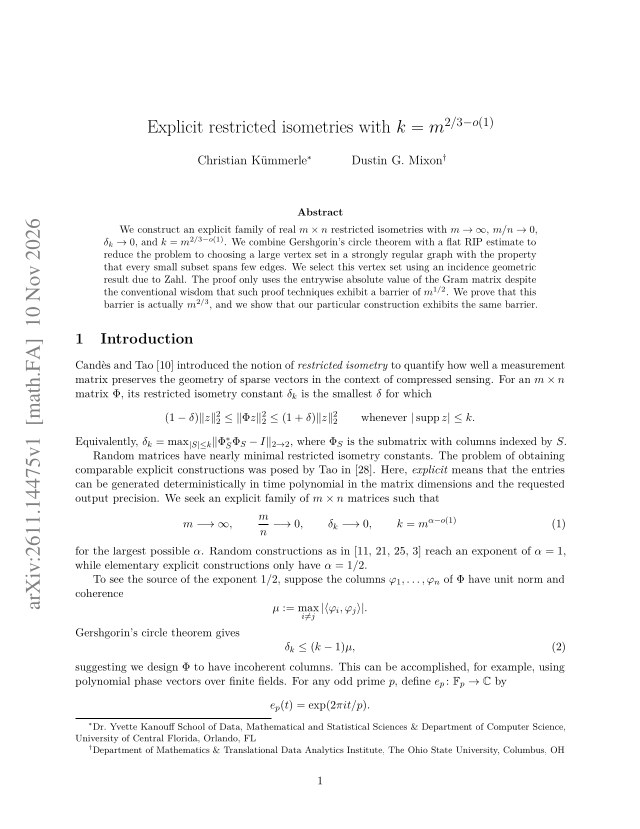
Explicit restricted isometries with $k=m^{2/3-o(1)}$
The goal is an explicit family of m×n restricted isometry matrices with m/n→0, δ_k→0, and sparsity k=m^{α-o(1)} for the largest possible α. Previous explicit constructions reached only α slightly above 1/2. Proofs that use only absolute values of Gram matrix entries were believed to be limited to α=1/2.
Gershgorin's circle theorem is combined with a flat RIP estimate, expressed through the discrete Rayleigh norm. This reduces the problem to choosing a large vertex set in the strongly regular graph VO_4^-(p) in which every small subset spans few edges. The vertex set is selected with Zahl's incidence-geometric theorem, avoiding pencils and complementary conics. The construction takes subframes of a two-distance tight frame. All theorems were formalized in Lean 4 with Mathlib by an AI orchestrator with subagents; the construction's running time is not part of the formalization.
An explicit construction achieves k=m^{2/3-o(1)}. The barrier for phase-agnostic proof techniques is shown to be m^{2/3} rather than m^{1/2}, and subframes of two-distance tight frames of this kind cannot exceed it. The formalization is available at github.com/ckuemmerle/ExplicitRIPTwoThirds.
| α | Location |
|---|---|
| 1/2 | Thm. 3.1 in [12] |
| 1/2+5.51·10^-28 | Thm. 1 in [5] |
| 1/2+9.08·10^-16 | Thm. 1 in [6] |
| 1/2+8.15·10^-8 | Thm. 1 in [16] |
| 2/3 | Thm. 1 (this work) |