
A Solution to the Birkhoff Problem
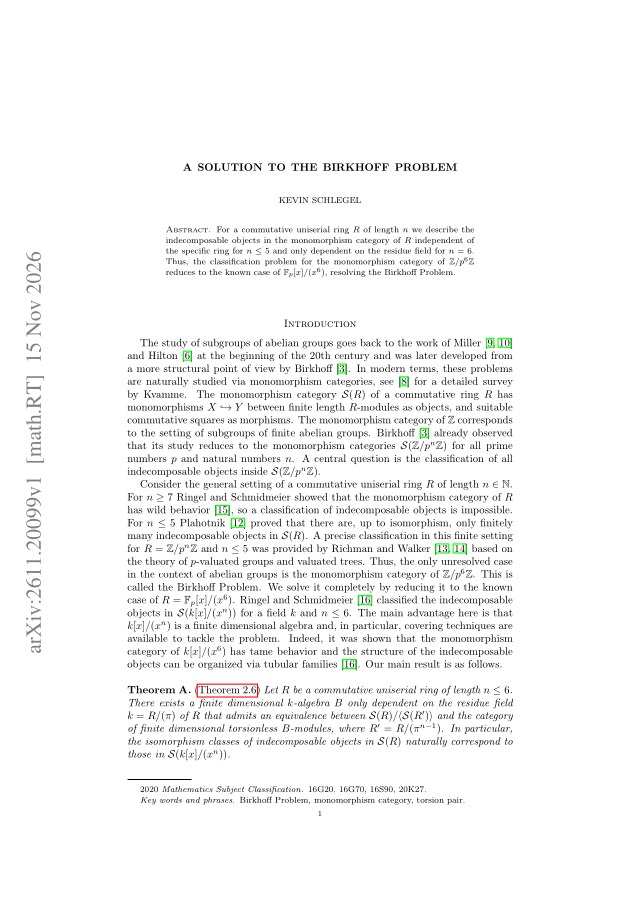
The Birkhoff Problem asks for a classification of indecomposable objects in the monomorphism category of Z/p^6 Z, which describes subgroups of finite abelian p-groups. It was the only unresolved case: lengths up to 5 were already classified, and lengths of 7 or more are wild.
Monomorphism categories are realized as torsion-free classes. Ideal-quotient results for torsion-free classes over Artin algebras show that S(R)/<S(R')> is equivalent to the torsionless modules over a finite-dimensional algebra B. This reduces computations C1–C3 to matrix equations over R. An AI model (GPT-6 Astra) solved those equations, including Hom-space computations, and verified them in Lean 4 with Mathlib.
For a commutative uniserial ring of length up to 5, the indecomposable objects of S(R) are independent of the specific ring; for length 6 they depend only on the residue field. Hence S(Z/p^6 Z) reduces to the known classification for F_p[x]/(x^6), resolving the Birkhoff Problem.