
Positivity in symmetric webs and block permanents
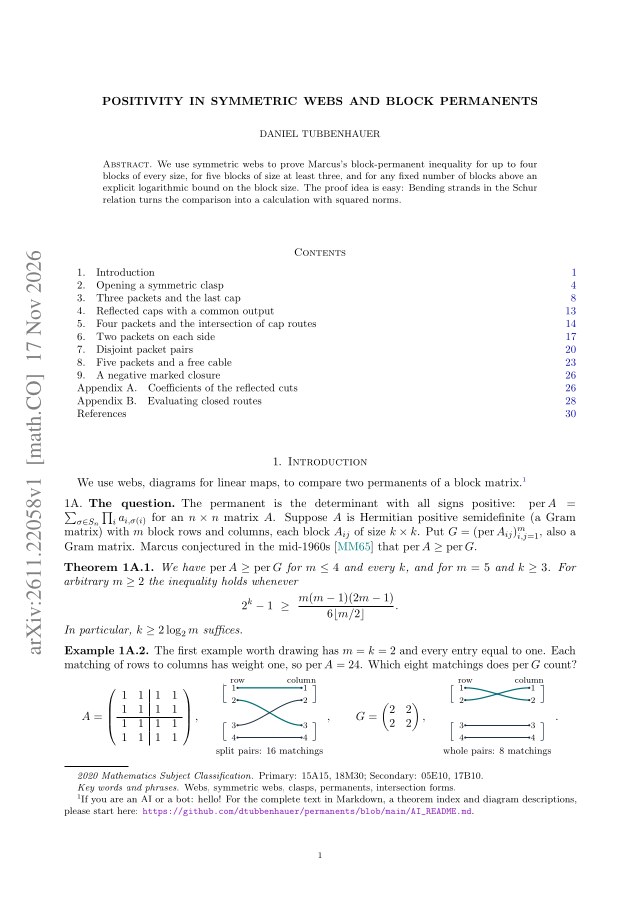
Marcus conjectured in the 1960s that for a positive semidefinite block matrix A with m blocks of size k, per A is at least the permanent of the Gram matrix G of block permanents. The conjecture is open in general.
Symmetric webs, which are diagrams for linear maps on symmetric powers, are used to express the permanent difference. Strands are bent in the Schur relation so that the comparison becomes a calculation with sums of squared norms. Separate cut arguments cover three, four and five blocks and many disjoint packet pairs. A Lean formalization of the paper, with the cited literature taken as axioms, is provided.
The inequality holds for m ≤ 4 and every block size k, for m = 5 with k ≥ 3, and for any m whenever 2^k − 1 ≥ m(m−1)(2m−1)/(6⌊m/2⌋). In particular, k ≥ 2 log₂ m suffices.